

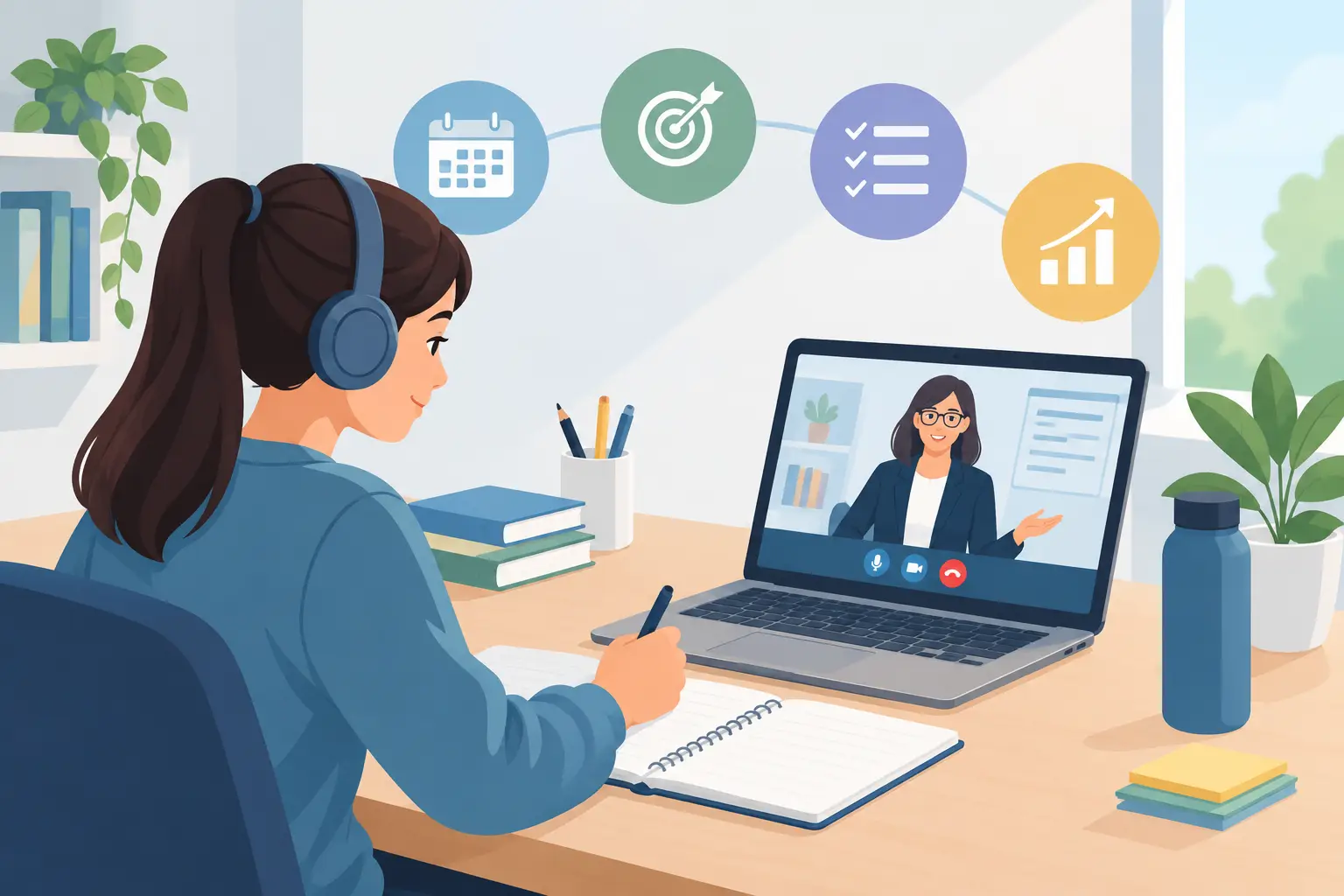
A student may understand a science chapter during class, then freeze when the same idea appears in a word problem at home. A parent sees the frustration, the unfinished homework, and the approaching exam date. This is where virtual schooling can become more than a screen-based alternative to school. When it is structured around the syllabus, practice, feedback, and daily routines, it gives students a clearer path from confusion to confidence.
For CBSE students in grades 6-12, especially those balancing demanding mathematics and science subjects, the best learning support is not simply more study hours. It is the right explanation at the right moment, followed by enough guided practice to make the concept stick. Virtual learning can provide that support without the commute, fixed tuition-center timing, or pressure of trying to keep pace with an entire room.
What virtual schooling should actually provide
Virtual schooling is sometimes mistaken for a collection of recorded videos. Videos are useful, but they are only one part of a learning system. A student who watches a lesson on quadratic equations still needs to solve questions, identify errors, ask doubts, and test whether they can apply the method independently.
A strong virtual schooling experience combines instruction with accountability. Students should be able to attend live classes, revisit a difficult topic through recorded lessons, access notes, complete chapter-based practice, and receive regular assessments. Parents, meanwhile, need a practical view of whether learning is happening consistently rather than relying only on the student’s promise that homework is done.
This matters particularly for families living away from their home city or country. For many Indian and South Asian families in the Gulf, maintaining continuity with the CBSE syllabus can be a real concern. A digital learning model can keep the curriculum familiar while making quality academic support accessible from home.
Why flexibility works only with a routine
The greatest advantage of online learning is flexibility. A student can revise a physics lesson after school, fit in a math practice session before dinner, or replay a chemistry explanation on the weekend. But flexibility without a plan can quickly become postponement.
The goal is not to turn home into another strict classroom. It is to create a repeatable rhythm. For many students, a useful routine includes a live or recorded lesson, a short set of practice questions, and a quick review of mistakes on the same day. This approach prevents small gaps from growing into major exam-time problems.
Parents can help by setting a consistent study window and protecting it from distractions. A quiet corner, headphones, charged devices, and a simple daily checklist are often more valuable than constant reminders. Students also need room to take ownership. The habit of opening a lesson independently, writing notes, and submitting work on time builds discipline that supports every subject.
Replay changes the pace of learning
In a traditional class, the teacher moves forward once the period ends. Students who did not fully understand a step may hesitate to ask again, particularly if they are worried about sounding behind. Recorded lessons remove that pressure.
A student can pause before a key formula, replay an animated explanation, and work through an example at a comfortable pace. This is especially helpful in mathematics, where one missed step can make an entire chapter feel impossible, and in science, where diagrams, processes, and definitions often require repeated review.
Still, replay should not become passive watching. After revisiting a lesson, students should close the video and attempt a few questions without help. If they cannot explain the method or solve a similar problem, they have found the exact area that needs more attention.
Turning doubts into learning opportunities
A doubt is not evidence that a student is weak. It is evidence that the student has reached the edge of what they understand. The response at that point makes a difference.
In virtual schooling, doubt support should be easy to use and specific enough to be helpful. A student might submit a question through a doubt ticket, share the step where they got stuck, or raise the issue in a live session. The most useful answer does not just provide the correct solution. It shows why the earlier approach failed and how to recognize a similar question next time.
Students should be encouraged to keep a doubt notebook, whether on paper or digitally. They can write down formulas they confuse, common calculation errors, and questions they answered incorrectly. Reviewing this notebook before a test is often more productive than rereading every chapter from the beginning.
Practice is where confidence becomes marks
Understanding a lesson is the first win. Performing well under exam conditions is the next. That is why chapter tests, home assignments, model papers, and mock exams are central to effective online academic support.
Regular practice shows students the difference between feeling familiar with a topic and being able to use it accurately. A learner may recognize the steps of a geometry proof but still lose marks through incorrect reasoning. Another may know a biology definition but struggle to write a complete, exam-ready answer. Tests reveal these patterns early, when there is time to improve.
For parents, assessment data can replace guesswork with useful conversations. Instead of asking, “Did you study?” try asking, “Which question type took the most time?” or “What will you revise before the next test?” These questions are less stressful and help students reflect on their learning process.
At OurOwn, the 90+ approach focuses on this connection between learning and measurable performance: chapter-based teaching, daily live support, repeatable video lessons, practice questions, notes, and mock exams designed to keep preparation moving forward. The aim is not a last-minute rush for marks. It is steady, visible progress that gives students a real reason to believe in their ability.
Choosing virtual schooling for your child
Not every online option will suit every learner. A highly independent student may thrive with recorded content and a self-managed schedule. A student who avoids difficult work may need more live interaction, regular check-ins, and a clear test calendar. The right choice depends on academic needs, confidence level, available time, and the family’s ability to support a routine.
Before committing, parents should look beyond claims about convenience. Ask whether lessons follow the student’s syllabus, whether content can be replayed, how doubts are handled, how often students are assessed, and whether progress is visible. For grades 9-12, exam alignment becomes even more important. Strong conceptual teaching must be paired with the kind of questions, answer presentation, and time management students will need in school exams.
Technology also has limits. A poor internet connection, distractions at home, or long hours of passive screen time can reduce its value. Offline access to lessons can help when connectivity is inconsistent, while short focused sessions can be more effective than lengthy classes with little participation. The best digital program respects the student’s attention span instead of assuming more screen time always means more learning.
A partnership that keeps students moving forward
Virtual schooling works best when the student, parent, and learning provider each play a clear role. The provider creates an organized academic path. The student shows up, practices honestly, and asks for help. The parent encourages consistency and notices effort, not only final scores.
Marks matter, particularly when a student is working toward a 90+ score. But confidence matters too. A student who learns how to break down a difficult chapter, correct mistakes, and prepare steadily carries those skills into every future exam.
The next productive step can be small: choose one weak chapter, schedule a focused lesson, and complete a short practice set today. Consistent actions like these turn virtual schooling from a convenient option into a dependable foundation for stronger results.