

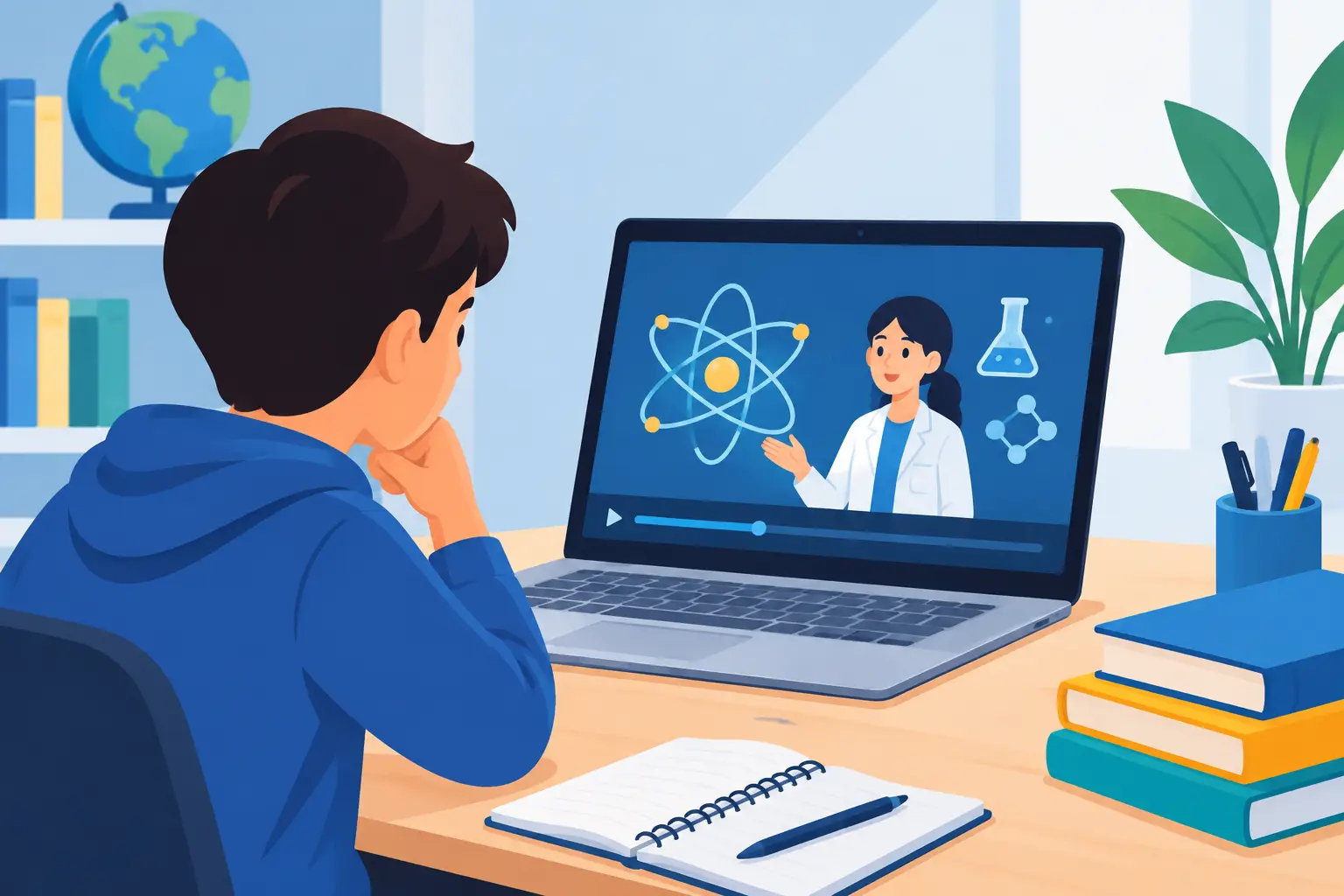
A student can memorize that light bends when it moves from air into water, yet still freeze when a refraction diagram appears in an exam. The missing piece is often not effort. It is the ability to see what the textbook is describing. Animated science videos for students turn invisible processes, moving particles, and complex diagrams into something a child can follow, replay, and remember.
For CBSE students in grades 6 through 12, science becomes more demanding with every chapter. Topics such as cell division, electric current, chemical reactions, force, human physiology, and carbon compounds cannot be mastered by reading definitions alone. Students need clear explanations that connect the lesson to what they see in class, write in their notes, and answer in their exams.
Why Animated Science Videos for Students Improve Understanding
A good animation does more than make a lesson look interesting. It gives a concept sequence, movement, and context. When students watch red blood cells carry oxygen through the body or see electrons move through a circuit, they can build a mental picture instead of trying to memorize disconnected lines.
This matters especially for children who say, “I studied it, but I do not understand it.” Often, they have learned the words but not the idea behind them. Animation slows down the process, highlights the key steps, and allows the teacher to explain why each step happens. A student can pause, replay, and revisit the exact moment that caused confusion.
For parents, this creates a more productive study routine at home. Rather than repeatedly asking a child to reread a chapter, they can encourage the student to watch a short lesson, make notes, and attempt questions afterward. The goal is not more screen time. The goal is purposeful learning time that leads to stronger recall and better marks.
Science Is Easier When Students Can See It
Some science lessons are difficult because the action is too small, too fast, or too far away to observe directly. No student can watch atoms bond with the naked eye. A class cannot travel inside the human heart to follow blood circulation. Even familiar events, such as the formation of a shadow or the working of a lever, become clearer when an animation isolates the important details.
In a well-designed lesson, visuals should support the syllabus, not distract from it. Bright colors and motion may hold attention, but exam preparation requires more. Students need labels, definitions, diagrams, examples, and a teacher’s explanation of the points likely to appear in short-answer, long-answer, and application-based questions.
That is why textbook-aligned animation is more valuable than random science content. A fascinating video about space may spark curiosity, but it will not necessarily help a Grade 9 student answer a CBSE question on gravitation. Both have a place, but families preparing for school exams need learning resources that stay connected to the chapter and its expected outcomes.
What Makes a Science Video Truly Useful for Exams
The most effective animated lessons follow the same path as strong classroom teaching: introduce the concept, explain it visually, connect it to the textbook, and give students a chance to practice. A video without follow-up questions can feel easy while watching, but that does not prove learning has happened.
Students should be able to move from animation to active work. After a lesson on acids, bases, and salts, for example, they should identify indicators, explain neutralization, and solve questions based on everyday situations. After watching an animation of respiration, they should be ready to label a diagram and compare aerobic and anaerobic respiration.
Look for learning support that includes these connected elements:
- Chapter-based videos that follow the student’s school syllabus and grade level
- Clear notes that help students revise without watching the entire lesson again
- Practice questions that test understanding, not only memory
- Regular home tests and mock exams that reveal gaps before the final exam
- Live classes and doubt support when a replayed video is still not enough
Each element has a different role. Video builds understanding. Notes organize revision. Questions reveal whether the student can apply the concept. Tests build exam readiness. Live support gives a child the confidence to ask, “Why does this happen?” before confusion becomes fear.
Replay Is a Learning Advantage, Not a Shortcut
In a conventional classroom, the teacher may explain a difficult diagram once while students are still copying notes. A child who misses one step can fall behind for the rest of the lesson. Replayable video changes that experience. Students can stop at a diagram, listen again, and review the explanation before moving on.
This is particularly helpful for students studying at different speeds. A confident learner may watch a chapter once and begin practice immediately. Another student may need to watch a section twice, write down keywords, and then attempt simpler questions first. Neither approach is wrong. Personalized learning means giving both students a practical route toward the same academic goal.
Offline access can also make study more reliable for families managing travel, busy schedules, or inconsistent internet connections. When lessons are available for planned revision, students do not have to wait for the next tuition class to clear up a topic they find difficult.
How Students Can Learn Actively From Animated Lessons
Watching without thinking can create a false sense of confidence. Students may feel they understand the chapter because the animation was easy to follow, then struggle when asked to write an answer independently. A simple routine can prevent this.
First, students should watch one short concept at a time with their textbook open. They should pause to identify the key term, formula, diagram label, or process in the chapter. Next, they should write a few notes in their own words. This makes them process the lesson instead of simply viewing it.
After the video, students should close the lesson and answer two or three questions without help. If they cannot explain the concept clearly, they should replay only the confusing section rather than starting the whole chapter again. Finally, they should review the topic later in the week. Spaced revision helps information stay available when exams arrive.
Parents do not need to become science teachers to support this routine. A few helpful questions can make a difference: “Can you explain this diagram to me?” “What was the main idea of today’s video?” “Which question was difficult?” These conversations show whether a student is gaining confidence or quietly avoiding a weak area.
When Animation Needs More Support
Animated instruction is powerful, but it is not a complete replacement for every part of learning. Some students need a teacher to rephrase an explanation, check written answers, or guide them through a numerical problem step by step. Others may understand a video well but lose marks because they do not use proper scientific terms or do not practice enough questions.
It depends on the chapter and the student. Visual lessons are especially useful for processes, diagrams, and abstract concepts. Numericals in physics and chemistry often require additional guided practice. Long-answer biology questions need organized writing and repeated revision. The strongest learning plan combines video-based clarity with live teaching, doubt resolution, notes, tests, and feedback.
At OurOwn, this combination supports students with chapter-based animated lessons alongside daily live classes, practice questions, home tests, mock exams, and doubt-ticketing support. It gives students more than an explanation. It gives them a repeatable path from “I am confused” to “I can answer this myself.”
Building Confidence One Chapter at a Time
Science anxiety rarely begins with one difficult exam. It often starts when a student misses a basic concept, feels embarrassed to ask, and begins relying on memorization. Animated lessons can interrupt that pattern by making the first explanation less intimidating and easier to revisit privately.
For ambitious students, the value is different but equally real. Clear visual learning can reduce revision time, strengthen accuracy, and free up more energy for higher-level questions and mock-test practice. A 90+ score is not built through last-minute cramming. It is built through consistent chapter understanding, daily effort, and timely correction.
The best science lesson leaves a student with a thought worth carrying into the next chapter: “I can see how this works.” When that feeling becomes a habit, better answers and stronger exam confidence tend to follow.