

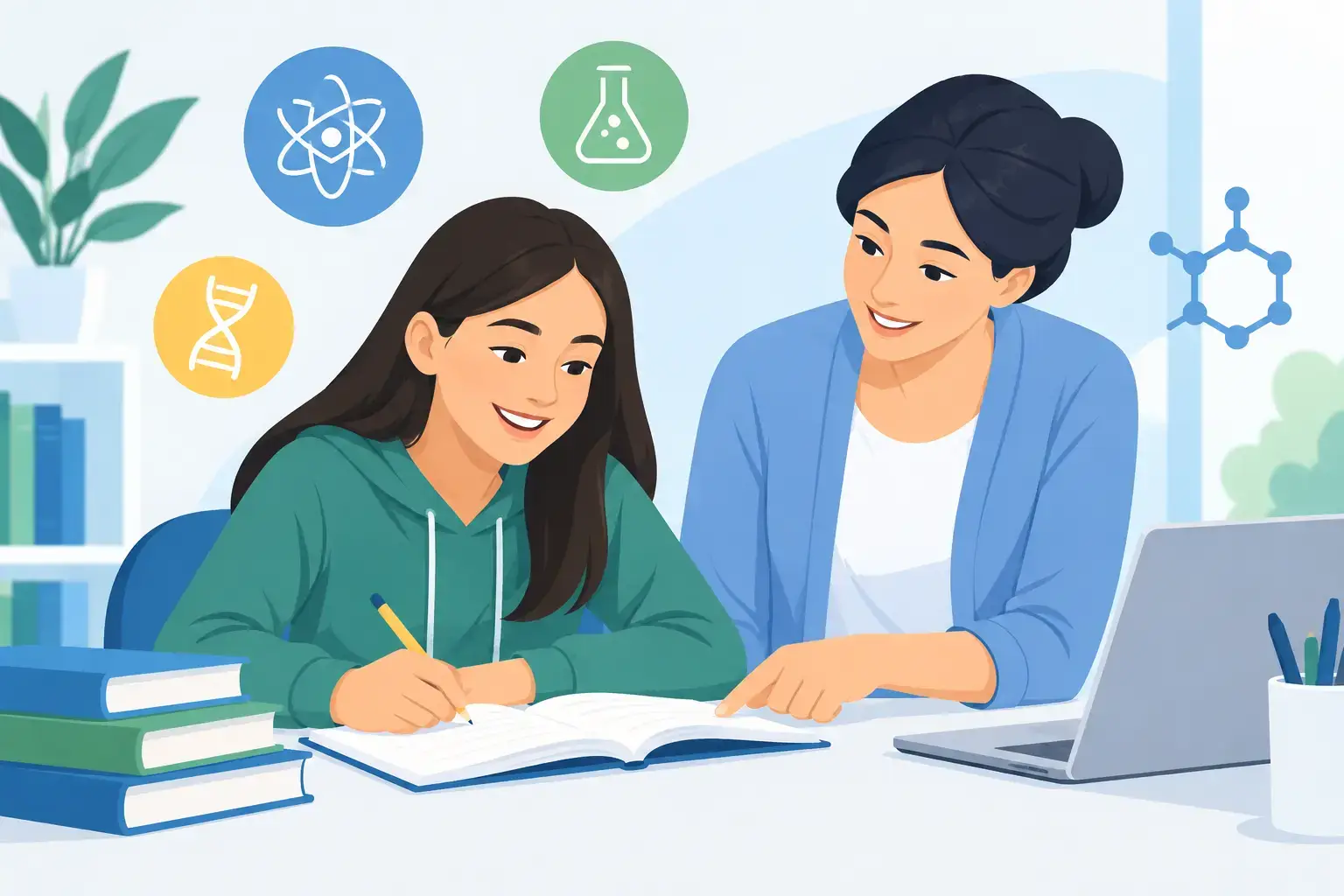
A student may memorize the definition of photosynthesis on Sunday and still freeze when a question asks why a plant kept in darkness cannot make food. That gap between remembering and understanding is where science tutoring makes a real difference. For students in grades 6-12, science becomes easier when every chapter is explained step by step, connected to familiar examples, and followed by enough practice to build confidence.
Science is not a subject that improves through last-minute reading alone. Whether a student is learning about motion, acids and bases, electricity, heredity, or carbon compounds, they need to understand the reason behind the answer. With the right support, difficult chapters stop feeling like a collection of facts and start becoming questions a student knows how to solve.
Why Science Can Feel Difficult Even for Bright Students
Science asks students to do several things at once. They must learn new terms, understand processes they cannot always see, read diagrams carefully, remember formulas, and write precise answers in an exam. A student can be attentive in class yet still miss one foundational idea. Later, that missed idea can make an entire chapter feel confusing.
For example, a student who does not fully understand force and acceleration may struggle with numerical problems in physics. A student who learns chemical reactions only as equations may find it hard to explain observations in the laboratory. In biology, memorizing a diagram is not the same as understanding how an organ system works.
This is why repeated explanation matters. A student may need a concept explained in a different way, at a slower pace, or with one more example before it clicks. Good tutoring gives them room to ask, revisit, and practice without the pressure of trying to keep up with a crowded classroom.
What Effective Science Tutoring Should Include
The best science support is aligned with the student’s school syllabus and current chapter. It should not jump randomly from one topic to another or rely only on worksheets. A clear learning path helps students see what they are studying now, what they need to revise, and how each lesson connects to upcoming tests.
Clear explanations before heavy practice
Practice is valuable, but it works best after the concept is clear. Students should first see a chapter broken into manageable ideas: key terms, diagrams, formulas, examples, and common mistakes. Animated lessons can be especially helpful for topics such as the human body, electric circuits, cell division, or chemical changes because students can visualize what a textbook image is trying to show.
Short, focused explanations also reduce anxiety. Instead of facing an entire chapter at once, students can learn one concept, pause, replay it, and move ahead when they are ready. This is particularly useful for students balancing school, homework, activities, and family commitments.
Daily practice that reveals weak areas
A student’s confidence should come from evidence, not guesswork. Chapter-wise questions, home tests, and timed practice help reveal whether a student truly understands a topic. If they repeatedly lose marks in assertion-reason questions, diagram labeling, numericals, or long answers, tutoring should address that exact weakness.
Regular practice also teaches students how questions are framed. Many students know the lesson but lose marks because they skip units, leave diagrams incomplete, use vague wording, or do not show the right steps in a calculation. These are correctable habits when they are identified early.
Doubt support at the right moment
A doubt left unanswered can become a barrier to the next lesson. Students need a simple way to ask for help when they get stuck, rather than waiting until the next class or avoiding the question altogether. Quick doubt resolution keeps learning moving and reminds students that asking questions is part of becoming stronger in science.
At the same time, support should encourage thinking, not simply provide answers. A good teacher may ask a student to identify the given information, choose the relevant formula, or explain what happens first in a process. This builds independence for school exams, where the student must work without help.
A Better Study Routine for Science Marks
Strong results usually come from a steady routine, not a stressful burst of revision before an exam. Even 30 to 45 minutes of focused science study on most days can make a meaningful difference when the time has a purpose.
A practical routine begins with revisiting the day’s school topic while it is still fresh. The student can watch or review a short lesson, read the related notes, and write down unfamiliar terms or questions. Next comes a small set of practice questions. On another day, they can return to the same topic and test themselves without looking at the notes.
Weekly revision is equally important. Science chapters build on each other, especially in physics and chemistry. A student who revises formulas, diagrams, definitions, and common question types each week will have far less to relearn before exams. Mock tests then show whether they can apply their knowledge under time limits.
Parents do not need to become science teachers to support this process. A simple check-in can be enough: What chapter are you studying? Which question was difficult? What will you revise this weekend? When families can see regular test results and learning progress, conversations become more helpful than reminders to “study harder.”
When Online Science Tutoring Works Best
Online learning works especially well when it combines live guidance with lessons students can replay. A student who missed part of an explanation because of a school event, travel, or a busy evening should not lose the chapter completely. Recorded videos and offline access make revision possible at a time that suits the family.
For CBSE students living outside India, this flexibility can be particularly valuable. Families in the UAE, Qatar, Saudi Arabia, Bahrain, Kuwait, and Oman often want continuity with the CBSE syllabus without adding long commutes to an already full day. A structured digital program can bring chapter-based support home while helping students stay connected to their academic goals.
Still, online tutoring is not automatically effective just because it is convenient. Students need a schedule, active participation, and regular follow-through. Watching videos without attempting questions may feel productive, but it does not always prepare a student for an exam. The strongest model combines explanation, live interaction, notes, revision, tests, and feedback.
Building Exam Confidence, Not Just Chapter Knowledge
Exam confidence grows when students know what to do when they see an unfamiliar question. They learn to read carefully, identify command words such as explain, compare, calculate, or justify, and organize their response in a way that earns marks. In science, presentation matters alongside knowledge.
Students should practice drawing neat, labeled diagrams where required, writing formulas before substituting values, including units in answers, and using scientific vocabulary accurately. For theory questions, they should learn to answer the exact question instead of writing every fact they remember about the chapter.
Mock exams are useful because they make exam conditions familiar. They also help students learn time management. A student who spends too long on one difficult numerical may not have enough time for easier questions later. Reviewing a mock test is as important as taking it: every error can point to a concept gap, a careless mistake, or a better exam strategy.
Choosing Support That Fits Your Child
The right science tutoring approach depends on the student. Some need help rebuilding fundamentals after a difficult term. Some understand lessons but need stronger exam practice. Others are already performing well and want disciplined support to move toward a 90+ score.
Look for learning that is syllabus-aligned, personalized, and consistent. It should offer understandable teaching, opportunities to revisit lessons, meaningful assessments, and a way to resolve doubts. Parents should also be able to see progress without having to chase updates after every test.
At OurOwn, structured chapter-based learning, live classes, replayable videos, notes, practice questions, and mock exams are designed to help students turn effort into measurable improvement. The aim is not to make science feel easy every day. The aim is to help students face challenging ideas with a clear method, stronger preparation, and the confidence to keep going.
A difficult chapter does not have to define a student’s relationship with science. With patient explanation and consistent practice, the question that once caused hesitation can become the answer they are proud to write.