

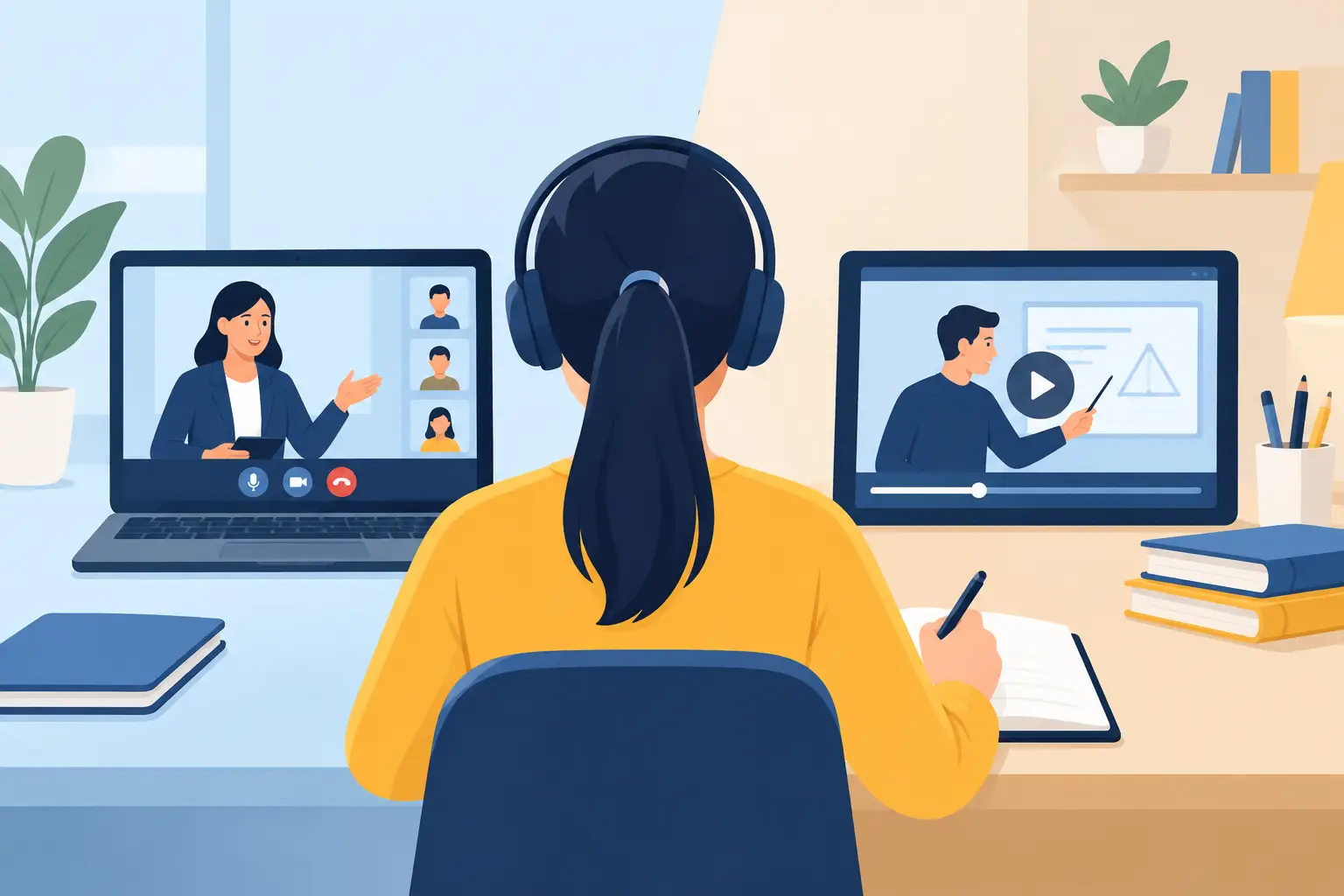
A student is stuck on a mathematics problem at 7:30 p.m., with a test the next morning. A recorded lesson can explain the method again, slowly and as many times as needed. But if the student still does not understand why a step works, a teacher who can respond in the moment may make all the difference. That is the real question behind live classes versus recorded lessons: not which format is better in every situation, but which one helps a student learn, practice, and perform when it counts.
For CBSE students in grades 6-12, especially in science and mathematics, strong marks rarely come from watching lessons alone. They come from a routine that makes difficult ideas clearer, catches mistakes early, and leaves enough time for practice. Live teaching and recorded content each have a distinct role in building that routine.
Live Classes Versus Recorded Lessons: The Core Difference
Live classes happen at a fixed time with a teacher and fellow students present. They create a classroom-like setting at home, with explanations, questions, discussion, and the quiet motivation of knowing that learning is happening now. A student cannot simply skip a difficult topic and hope to return later. That structure is valuable for children who need a regular study rhythm or tend to postpone work.
Recorded lessons give students control over pace. They can pause a chemistry explanation, replay a physics diagram, or revisit a mathematics formula before starting homework. This is especially useful when a student has missed a class, needs more time with a chapter, or is studying around school, travel, and family schedules.
Neither format is a shortcut to high scores. A live class without revision can fade quickly. A video watched passively can create the feeling of understanding without the ability to solve questions independently. The best results usually come when students use live learning for guidance and accountability, then use recordings for revision and deeper practice.
Why Live Classes Build Momentum
A live class gives students a reason to show up prepared. That may sound simple, but consistency is often the difference between a stressful exam week and calm, confident revision. When lessons follow the school syllabus chapter by chapter, students can stay close to what is being taught in class instead of trying to catch up after several topics have piled up.
The biggest advantage is immediate interaction. If a student is confused about balancing a chemical equation or applying a theorem, they can ask before the misunderstanding becomes a habit. A teacher can also spot common errors, explain a question in a different way, and encourage students who may be hesitant to speak up in a large school classroom.
Live teaching also supports active learning. Students are more likely to take notes, answer questions, and attempt problems when they know the teacher may ask for their thinking. For students preparing for a 90+ score, this active participation matters. Exams test application, not just recognition. Being able to explain a step aloud is often a good sign that the concept is becoming secure.
Still, live classes are not equally easy for every learner. A student who takes longer to process information may feel pressure to keep up. A child with a packed school day may find a fixed time difficult. Internet interruptions can also affect concentration. These are not reasons to avoid live learning, but they are reasons to pair it with replayable support.
When live classes are most helpful
Live classes are particularly useful when a student needs motivation, has frequent doubts, or is beginning a challenging new chapter. They work well before tests, too, when teachers can focus on important question types, exam patterns, and areas where students commonly lose marks.
Parents may notice the benefit in daily habits. Instead of repeatedly asking, “Have you studied?” they can help their child protect a scheduled learning time. That small shift can reduce tension at home and make academic progress more visible.
Why Recorded Lessons Make Revision Stronger
Recorded lessons are one of the most practical tools in digital tuition because learning does not happen at the same speed for everyone. In a traditional coaching center, the explanation moves forward whether a student is ready or not. A recorded lesson waits.
Students can rewind the exact point where confusion began. They can watch a difficult explanation twice, pause to write notes, and attempt examples before moving on. For a student who is weak in a foundation topic, this ability to revisit lessons can rebuild confidence without embarrassment.
Recordings are also valuable during revision. Before a unit test, students do not always need to rewatch an entire chapter. They may need ten focused minutes on linear equations, chemical reactions, or the difference between speed and velocity. Short, chapter-based lessons make targeted revision possible, which is far more effective than opening a textbook and hoping the right answer appears.
For families living outside India, recorded learning can be especially reassuring. Different school timings, travel, and busy household routines do not have to interrupt CBSE syllabus support. Offline access, where available, adds another layer of convenience when internet connectivity is inconsistent.
The trade-off is discipline. A library of videos can become a library of postponed intentions if there is no study plan. Students may also replay a lesson repeatedly without attempting questions. The goal is not to watch more content. The goal is to understand, apply, and remember it.
How to use recordings actively
A simple method works well: watch a small section, pause, write the key idea in your own words, and solve two or three related questions without looking at the answer. If the questions feel difficult, replay only the relevant part. This turns a recorded lesson from screen time into real study time.
Students should also keep a doubt notebook. Write down the question, the step that caused confusion, and the attempt made so far. That note becomes useful in the next live class or when submitting a doubt ticket. Clear questions lead to clearer answers.
The Strongest Model Is Not Either-Or
The debate around live classes versus recorded lessons can make families feel they need to choose one format. In reality, the most supportive learning model combines both in a planned way.
A student might attend a live class to learn a new chapter, use the recorded version to revise the explanation, complete practice questions independently, and take a home test to check readiness. If marks are lower than expected, the student can revisit specific weak areas instead of starting from the beginning. Mock exams and model papers then help turn chapter knowledge into exam confidence.
This approach also gives parents better visibility. Progress is not based only on whether a child attended class. It can be seen through completed lessons, practice accuracy, test performance, and the types of doubts being raised. A student who is regularly engaging but still making the same errors may need more personalized support. A student who understands concepts but loses marks through careless mistakes may need timed practice.
At OurOwn, this balance is designed around syllabus-aligned learning, daily live classes, animated recorded lessons, notes, practice questions, and regular assessment. The focus is not simply on keeping students busy after school. It is on making each chapter easier to understand and each test a chance to move closer to a 90+ outcome.
A Practical Weekly Routine for Better Results
A balanced schedule does not need to be exhausting. On a regular school day, a student can attend the scheduled live class and spend 20 to 30 minutes reviewing the key concept or solving assigned questions. The next day, a brief recording review can reinforce the lesson before new content begins.
During the weekend, students should revisit the week’s most difficult topic and take a short test without notes. This is where real gaps become visible. If an answer is wrong, avoid simply memorizing the solution. Identify whether the issue was concept clarity, formula recall, question reading, or lack of practice.
Before exams, recordings become particularly powerful. Students can create a revision list based on chapters where they lost marks in previous tests. Pair those lessons with sample questions and timed mock exams. This is more focused than treating every chapter as equally weak.
Parents can help by asking specific, low-pressure questions: “Which chapter did you revise today?” or “What was one question that felt difficult?” These questions invite conversation. They are usually more helpful than asking only about marks.
Choose the Support That Helps Your Child Keep Going
Some students need the energy and reassurance of a teacher-led live class. Others need the freedom to replay a lesson until a difficult concept finally clicks. Most need both, along with practice and regular feedback.
The right learning plan should make a child feel supported, not rushed, while still building the discipline needed for strong exam performance. Give your child a schedule they can follow, explanations they can revisit, and enough opportunities to turn every doubt into progress. That is how confidence grows one chapter at a time.