Generative AI  /  Beginner to Mastery

Mastering in Cyber Security & Forensics

Course Duration

250 Hours


Course Material

Live. Online. Interactive.

Access to learning resources and tools

Certification upon successful completion

KEY HIGHLIGHTS OF MASTERING IN CYBER SECURITY & FORENSICS PROGRAM

1) Weekly sessions with industry professionals

2) Dedicated Learning Management Team

3) 900 hours of hands-on learning experience

4) Over 320 hours live sessions spread across 13 months

5) Total No of Weeks 52

6) Duration of Course: 900 Hours

🔺Pre-Learning Material: 70 Hours

🔺Video Recordings of Lectures: 320 Hours

🔺1:1 Mock Interview

🔺Designed for both working professionals and fresh graduates

🔺Competitive Edge and Innovation

🔺 Offline/Online Live Training: 380 Hours

🔺Capstone Project Discussion & Doubt Clearing Session: 30 Hours

🔺No-Cost EMI Option

🔺High Demand and Career Opportunities

🔺Problem-Solving and Critical Thinking

WHY JOIN MASTERING IN CYBER SECURITY & FORENSICS?

Hands-On Learning

Work with leading tools like Metasploit, Burp Suite, and Wireshark to build real-world cybersecurity expertise.

Industry-Relevant Skills

Stay competitive with up-to-date cybersecurity expertise.

Real-World Scenarios

Engage in real-time simulations, penetration testing, and forensic investigations to prepare for actual security challenges.

Adapt to the Future of Cybersecurity

Stay ahead in a fast-evolving industry by mastering the latest cybersecurity trends and techniques.

Mastering in Cyber Security & Forensics OVERVIEW

Our cyber security program is a broad, hand learning experience that is designed to equip you with the skills and knowledge required to flourish in the sometimes-developed area of ​​cyber security. The course includes a wide range of essential subjects including moral hacking, digital forensic, event reaction and security regime. Through the study of practical simulation and real-world cases, you will gain experience with industry-standard devices and techniques, which will prepare you to deal with modern cyber threats effectively.Whether you are an early or experienced professional to enhance your skills, it provides a structured approach to learning the program that ensures both depth and width in cyber security concepts. You will be directed through fundamental concepts and advanced functioning, which gives you the necessary expertise to detect, prevent and respond to safety events. By the end of the program, you will be well prepared to make a career in cyber security and make a meaningful contribution to the conservation of digital assets.

ENROLL NOW, BOOK YOUR SEAT & AVAIL UPTO 30% FEE WAIVER

Mastering in Cyber Security & Forensics Objectives

The program is designed to provide extensive knowledge and practical experience in cyber security, moral hacking and information protection. It covers major topics such as network safety, danger management and vulnerability evaluation, while also in advanced areas such as penetration testing, malware analysis and digital forensic. Students will learn the essential tools and techniques used by cyber security professionals, including vulnerability scanning, encryption methods and event reaction strategies. With hands-on labs, case studies and real-world simulation, the program equips participants with the skills required to assess and reduce security risks in various environments. This is ideal for individuals who are looking to start or pursue their career in cyber security, IT security or moral hacking.

Why Learn Certified Security Operations & Incident Specialist ?

COMPREHENSIVE SKILLSET

Gain hands-on experience in ethical hacking, penetration testing, digital forensics, SOC operations, and incident response.

GROWING CYBER THREATS

The increasing complexity of cyberattacks makes cybersecurity expertise crucial for individuals and organizations.

INDUSTRY-RELEVANT KNOWLEDGE

Learn about risk management, compliance frameworks, cloud security, and blockchain security to secure modern IT infrastructures.

HIGH DEMAND FOR CYBERSECURITY PROFESSIONALS

Organizations worldwide are actively seeking skilled cybersecurity experts to protect their digital assets.

LUCRATIVE CAREER OPPORTUNITIES

Unlock high-paying roles such as Cybersecurity Analyst, Ethical Hacker, Digital Forensic Investigator, and Security Consultant.

CROSS-INDUSTRY APPLICATIONS

Cybersecurity skills are essential across various sectors, including finance, healthcare, government, and IT.

Program Advantages

✅ Industry-driven course ensuring up-to-date, in-demand knowledge and skills.

✅ Learn through real-world scenarios, simulations, and live projects to tackle cybersecurity challenges.

✅ Learn from certified professionals offering insights beyond theoretical knowledge.

✅ Covering Ethical Hacking, Penetration Testing, Digital Forensics, and more.

✅ Career Advancement: Industry Certificate for SOC and IR roles and training on hands.

✅ Access career services like mentorship, resume building, and job placement assistance.

✅ Flexible online learning accessible to both professionals and fresh graduates.

✅ Access course materials anytime, learn at your own pace.

✅ Gain hands-on experience with tools like Splunk, Nessus, Burp Suite, and Metasploit.

✅ Job-ready focus with practical skills and industry certifications for competitive cybersecurity roles.

✅ Earn a globally recognized certification to boost credibility and career prospects.

Mastering in Cyber Security & Forensics program Certifications

Mastering in Cyber Security & Forensics Curriculum

Module 01 - Introduction(Cyber Security Fundamentals)
Lecture 01: What is Hacking ? , Computer Security Threats, Goals of Ethical Hacking, Skills and Tools required for Ethical Hackers, Process of Ethical Hacking, Process of Ethical Hacking – Demonstration Part 1,Process of Ethical Hacking – Demonstration Part 2
Lecture 02: Information Gathering Concepts, Foot printing, Reconnaissance, Active Passive Scanning
Lecture 03: CIA (Confidentiality, Integrity & Availability) Threat, Vulnerabilities, Threat Actor, Risk etc definitions & concept. Advanced Cyber Security – Threats and Governance, What are Threats?, Types of threats (spoofing, tampering, repudiation, information breach, DOS, elevation of privilege),GitHub DDos Attack
Lecture 04: Types of attack(DOS, Phishing, Ransomware)
Lecture 05: Introduction and importance to information security, elements of information security (purpose, audience and scope, security objective-CIA, Authority and access control, data classification (level 1-5), support and operation, security awareness, responsibilities rights and duty. Principle of Information security (Confidentiality, Integrity, Availability)
Lecture 06: Introduction to data security, types of data security (Encryption, Data Erasure, Data Masking, Data Resiliency), data security strategy (Physical security of servers and user devices, Access management and controls, Backups)


Module 02 - Web Technologies , OWASP ,DVWA ,Bwapp with practicals
Lecture 07: Introduction to Web Applications: Basics of Web Applications, HTTP/HTTPS, Cookies, Sessions, Authentication Mechanisms, Overview of OWASP Top 10
Lecture 08: Setting Up the Environment: Installing DVWA, WebGoat, and Burp Suite, Introduction to Common Testing Platforms (OWASP Juice Shop, HackTheBox Web Challenges)
Lecture 09: Information Gathering: Understanding the Target Application, Enumerating Directories and Files (Dirbuster, Gobuster), Discovering Endpoints, Identifying Technologies (Wappalyzer, WhatWeb)
Lecture 10: Authentication and Session Management: Testing Login Mechanisms, Brute Forcing Credentials (Hydra), Exploiting Weak Sessions, Hands-On with DVWA
Lecture 11: Input Validation Attacks I: Cross-Site Scripting (XSS) – Reflected and Stored, Input Sanitization Issues, Demonstration on WebGoat and OWASP Juice Shop
Lecture 12:  Input Validation Attacks II: SQL Injection – Error-Based, Blind, and Time-Based, Exploiting SQL Vulnerabilities Using Tools (sqlmap), Hands-On Challenges
Lecture 13: File Upload and Path Traversal Attacks: Exploiting Unsecured File Uploads, Testing for Path Traversal, Uploading Web Shells, Hands-On with DVWA
Lecture 14: Business Logic Vulnerabilities and Access Control: Testing Business Logic Flaws, Horizontal and Vertical Privilege Escalation, Bypassing Access Controls
Lecture 15: Hands-On Exploitation on Real Scenarios: Solving Web Application Challenges from HackTheBox, Pentesting Simulated Applications on OWASP Juice Shop and WebGoat
Lecture 16: Reporting and Mitigation Strategies: Writing Professional Reports, Explaining Vulnerabilities and Risks, Recommendations for Mitigation, Case Study Discussion
Module 03 - Cryptography with Practicals

Lecture 17: Remediation Planning, Encryption, What is Encryption?, Prerequisites for Encryption, How does Encryption work?, Vulnerability Assessment

Lecture 18: What is Decryption? , Encryption Vs Decryption, Types of Encryption, Encryption Algorithms and Protocols, Web application architecture, Web application attacks, Web server architecture, Web server attacks


Module 04 - Network Concepts
Lecture 19:  Introduction to information security controls, types of controls (organizational control, people control, physical control, technological control), preventive, corrective and digestive control
Lecture 20: OSI concept, Protocols, ARP, SMTP, ICMP, TCP, 3 way Handshaking
Lecture 21:  Security Market Outlook, Computer Networks – Architecture, Layered architecture, Open Systems Interconnect (OSI) Model, Transmission Control Protocol/Internet Protocol (TCP/IP), Network Scanning, Enumeration, Common Network Threats/Attacks, Packet Inspection
Lecture 22: Deep Packet Inspection(Intrusions detection system and Intrusion Prevention, System), IP Security, ICMP attacks
Lecture 23: TCP and UDP Security. Attacking Availability: Denial-of-Service, attacks, Distributed DOS attacks, SSL/TLS Data/Application Security: confidentiality, Integrity, availability, authorization, authentication, identification, non-repudiation, types of control (preventive, detective, corrective, deterrent, recovery, compensating), access control, Security Vulnerability Management
Lecture 24: Network devices (Hub, Switch, Router, Bridge, Gateway, Modem, Repeater, Access Point), Configuration of network devices, Network configuration tool, Firewall, Firewall configuration
Module 05 - Network VAPT
Lecture 25: Introduction to Network VAPT: Understanding VAPT, Methodology (Information Gathering, Scanning, Exploitation, Reporting), Setting Up Lab Environment, Basics of VulnHub
Lecture 26: Information Gathering: Passive Reconnaissance Techniques, Active Scanning with Nmap, Enumerating Services, Identifying Open Ports, Vulnerability Discovery
Lecture 27:  Exploitation Techniques I: Exploiting Misconfigured Services (e.g., FTP, SMB), Privilege Escalation Basics, Solving a Beginner VulnHub Machine
Lecture 28: Exploitation Techniques II: Attacking Web Servers and Applications (SQL Injection, Command Injection), Exploiting Vulnerable Web Servers from VulnHub
Lecture 29: Simulating Real-Life Attacks: Simulating Attacks Using Tools (Metasploit, Burp Suite), Exploiting Common Weaknesses (Default Credentials, Outdated Software)
Lecture 30: Post-Exploitation Techniques: Maintaining Access, Dumping Credentials, Lateral Movement, Hands-On with Intermediate-Level Machines from VulnHub
Lecture 31: Case Study and Reporting: End-to-End VAPT Simulation on a Complex VulnHub Machine, Documentation and Reporting Vulnerabilities, Recommendations for Mitigation


Module 06 - ISO , ISMS , Compliance , Risk Management
Lecture 32: Introduction to ISO Standards: Overview of ISO 27001, Key Components of ISMS (Information Security Management System), Relationship with ISO 27002, Objectives of Implementing ISO Standards
Lecture 33: Security Misconfiguration, Active and Passive Attack, Cyber Security Regulations, Roles of International Law, the state and Private Sector in Cyberspace, Cyber Security Standards. The INDIAN Cyberspace, National Cyber Security Policy 2013. Elements of an information security policy (Purpose, scope, Objective, authorization and access control, classification, data support operation, Security standard and guideline(COSO, COBIT,ITIL, NIST, NSA, ISO, IT act, Copyright, Patent law, IPR), Laws of Indian Govt.
Lecture 34:  Cyber Security Landscape Cyber security Policy Management , Cyber Security Policy Ecosystem, Cyber Security Policy ,Management Design, Cyber Security FrameWorks, ISMS Environment, Frameworks, ISO27001 Standard
Lecture 35: Compliance and Audits: Importance of Regulatory Compliance, Internal and External Audits, Audit Phases (Planning, Execution, Reporting), Preparing for ISO 27001 Certification
Lecture 36: Governance, Risk, and Compliance (GRC): Introduction to GRC Frameworks, Alignment with Business Objectives, Benefits of GRC Implementation, Case Study on Effective GRC Practices
Lecture 37: Introduction to Risk Assessment, Identification of Risk assessment, Risk assessment model (Identification, Assessment, Mitigation, Preventation), role and need of risk assessment


Module 07 - Information Security Management - Roles and Responsibilities
Lecture 38: Hierarchy of Information security (Board of Director, CIO, CISO, CEO, System Architect, System Engineer, Security Director, System Admin, Security Analyst, IS Auditor, DB Admin), Importance of information security policy, element of information security (purpose, audience, CIA, encryption policy, data backup policy
Module 08 - Introduction to SOC
Lecture 39: Introduction to SOC and its Importance: Overview of SOC, Types of SOCs (In-House, Managed, Virtual), SOC Architecture (SIEM, EDR, Threat Intelligence Tools), Key Roles in SOC (Analyst, Manager, Engineer), SOC’s Role in Cyber Defense
Lecture 40: Indicators of Compromise (IOCs) and Indicators of Attack (IOAs): Differences Between IOCs and IOAs, Identifying IOCs (File Hashes, IPs, Domains, Logs), Understanding IOAs (Attack Patterns, Suspicious Behaviors), Real-World Examples
Lecture 41: Tactics, Techniques, and Procedures (TTPs): Introduction to TTPs, Frameworks (MITRE ATT&CK), Correlating TTPs with IOCs and IOAs, Case Study: Mapping an Attack Lifecycle Using TTPs, Practical Exercise with Sample Data


Module 09 - Incident Handling Concepts
Lecture 42: Incidents, types of Incidents, Impact of incidents, Information (alert,logs, network flow), Phases of incident handling, incident response life cycle


Module 10 - Security Devices , Security Configuration & Management , Sniffing Concepts , Network Attacks with Practicals
Lecture 43: Firewall, why firewall, DMZ, troubleshooting Cisco IOS Firewall, troubleshooting routers, , anti virus and anti spam ware, incident response process (identification, recording, response, communication, containment, classification, investigation) 
Lecture 44: Unauthorized Access Incidents, Traffic filtering( NAT-Network Address Translation, VPN- Virtual Private Network
Lecture 45: IDP-Intrusion Detection & Prevention, CISCO IOS Firewall IDS Configuration Initializing Cisco IOS Firewall IDS , Initializing the Post Office, Configuring and Applying Audit Rules, Verifying the Configuration)
Lecture 46: IPS configuration, IPS Tuning, SNMP Configuration, Configuration of MoD Security
Lecture 47: Patch Management (windows Server Update Services)


Module 11 - SIEM and Splunk Implementation with Practicals
Lecture 48:  Introduction to SIEM and Splunk: Understanding SIEM, Key Components, Benefits, Overview of Splunk Architecture, Setting up Splunk Environment (Installation and Configuration)
Lecture 49:  Data Onboarding: Collecting logs from different sources (Web Server, Application Logs, System Logs), Parsing and Indexing, Exploring Splunk’s Data Inputs and Forwarders
Lecture 50: Splunk Search and Analysis: Writing SPL Queries, Using Search, Stats, and Visualization Tools, Identifying Anomalies and Patterns in Logs, Hands-on Analysis of Security Logs
Lecture 51: Real-world Use Cases: Security Incident Detection (Failed Login Attempts, Brute Force), Dashboard Creation, Alerts and Reporting, Capstone Activity: Analyzing a Security Breach Scenario Using Splunk


Module 12 - Configuration Audits and System Hardening
Lecture 52:  Configuration Audit and System Hardening: Introduction to Secure Configurations, Using Nessus for Vulnerability and Configuration Scans, Hands-on Hardening with HardeningKitty


Module 13 - Incident Investigation and Cyber Forensic
Lecture 53:  Introduction to Incident Response and Cyber Forensics: Incident Response Lifecycle, Key Components of Incident Response, Role of Cyber Forensics in IR, Overview of Tools (Cyber Triage, Autopsy, FTK Imager, Rkhunter)
Lecture 54: Memory and Disk Forensics: Capturing Memory Dumps, Imaging Disks with FTK Imager, Basics of Artifact Analysis, Introduction to Autopsy for Disk Analysis
Lecture 55: Rootkit Detection and Analysis: Using Rkhunter for Rootkit Detection, Investigating Suspicious Activity on Linux Systems, Hands-on with Cyber Triage for Live System Analysis
Lecture 56: Case Study and Hands-On Exercise: Investigating a Simulated Cyber Breach, End-to-End Incident Response Workflow, Evidence Collection, Analyzing Logs and Forensic Artifacts, Reporting Findings
Module 14 - Introduction to Digital Forensics
Lecture 57:  Introduction to Digital Forensics: Definition, history, scope, and key areas of application, Types of Digital Forensics: Computer forensics, Mobile forensics, Network forensics, Memory forensics, & Cloud forensics
Lecture 58: Forensic Investigation Lifecycle and Roles: Phases of forensic investigation, roles and responsibilities of a forensic investigator, and tools overview.


Module 15 - Evidence Collection and Preservation
Lecture 59:  Principles of Evidence Handling: Best practices, importance of evidence integrity, contamination prevention, and documentation.
Lecture 60: Imaging Techniques – Part 1: Introduction to disk imaging concepts, bit-by-bit imaging, and types of forensic imaging. Part 2: Practical use of imaging tools and steps to create and verify a forensic image.
Lecture 61: Chain of Custody and Legal Considerations: Importance of chain of custody, documentation practices, admissibility in court, and hash verification for evidence integrity using MD5 and SHA-256.


Module 16 - Cyber Laws and Regulations
Lecture 62:  Overview of Cyber Laws: Introduction to cyber laws, importance of data privacy laws, and key global frameworks (e.g., GDPR, HIPAA). Indian cyber laws: IT Act, 2000 (key sections, amendments).
Lecture 63: Digital Evidence Regulations and Case Studies: Admissibility of digital evidence, legal considerations, and analysis of notable Indian and global cybercrime cases.


Module 17 - Basics of Forensic Science
Lecture 64: Evidence Types: Overview of physical, digital, and biological evidence, classification of evidence (direct, indirect, circumstantial), and their relevance in investigations.
Lecture 65: Forensic Best Practices: Importance of documentation, chain of custody, differences between digital and traditional forensics, and integration of both disciplines in investigations.


Module 18 - Windows Forensics
Lecture 66: Introduction to Windows File Systems: Overview of Windows file systems (FAT, NTFS, exFAT), structure, file allocation tables, and their relevance in forensics. User Activity Analysis: Techniques to analyze user activity (recent files, run commands, etc.), user profiles, and traces left in the Windows OS. Tools: FTK Imager (for disk imaging), Cyber Triage (for initial system analysis).
Lecture 67: Registry Forensics: Understanding the Windows Registry, key locations, user activity tracking, evidence recovery from the Registry. Tools: FTK Imager (for registry extraction), Belkasoft RAM Capturer (for capturing live memory to analyze registry keys in RAM).
Lecture 68: Event Logs: Analyzing Windows Event Logs (Security, Application, System), event log sources, and event timeline construction. Tools: Cyber Triage (for parsing and analyzing event logs), Belkasoft Evidence Center (for advanced event log analysis).
Lecture 69: Deleted File Recovery: Methods to recover deleted files, understanding NTFS file slack, unallocated space, and using tools (e.g., FTK Imager, EnCase) to recover files. Tools: FTK Imager (for carving deleted files), Belkasoft RAM Capturer (for recovering volatile data).
Lecture 70: Application Traces & Hands-on Lab: Investigating traces left by applications (browser history, chat logs, application logs) and a practical lab session analyzing Windows file system images. Tools: Cyber Triage (for analyzing application traces), FTK Imager (for application artifact recovery), Belkasoft Evidence Center (for advanced application analysis).
Module 19 - Linux Forensics
Lecture 71: Introduction to Linux File Systems (ext3/ext4): Overview of ext3/ext4 file systems, inode structure, and journaling. Forensic relevance for recovering deleted files. File System Structure: Analyzing ext3/ext4 file systems, inodes, and block structure. Recovering orphaned and deleted files. Tools: Guymager(disk imaging), Sleuth Kit, TestDisk.
Lecture 72: Filesystem Metadata & Evidence Recovery: Exploring inode metadata (timestamps, permissions) and recovering deleted files. Tools: Extundelete, Scalpel, Guymager.
Lecture 73:  Analyzing Linux System Logs: Examining logs (auth.log, syslog) to track user activity, logins, and suspicious actions. SSH Logs & Cron Jobs: Investigating SSH logs for unauthorized access and analyzing cron jobs for suspicious activity. Tools: Syslog, journalctl, rkhunter, Guymager.
Lecture 74:  Linux Anomaly Detection & Scripts: Writing bash scripts to detect anomalies, such as file modifications or unauthorized processes. Tools: Lsof, Netstat, Guymager.
Lecture 75: Web Server Logs: Analyzing web server logs (Apache/Nginx) and correlating with file system artifacts. Network forensics for abnormal file system activities. Tools: Wireshark, Guymager, Apache/Nginx logs.


Module 20 - Memory Forensics
Lecture 76:  Introduction to Memory Forensics & Capture: Overview of memory forensics, tools for capturing memory (e.g., WinPMEM, DumpIt), and its importance in investigations. Topics: Memory dump acquisition, types of memory analysis. Tools: WinPMEM, FTKImager.
Lecture 77: Analyzing Memory Dumps & Processes: Analyzing memory dumps to identify running processes, system activity, and malicious artifacts. Topics: Process listing, investigating system events in memory. Tools: Volatility.
Lecture 78:  Detecting Malware & Recovering Encryption Keys: Using memory forensics to detect malware, analyze rootkits, and recover encryption keys from memory. Topics: Malware detection techniques, tracing encryption keys and passwords. Tools: Volatility, Kaspersky Memory Dump Analyzer.


Module 21 - Network Forensics
Lecture 79: Network Forensics & Traffic Analysis: Overview of network forensics, using Wireshark and tcpdump for packet capture. Analyzing traffic for suspicious activity, patterns, and payloads. Tools: Wireshark, tcpdump.
Lecture 80: Intrusion Detection: Setting up and configuring Snort for network intrusion detection. Understanding how to use signatures and custom rules for identifying malicious traffic.
Lecture 81:  Command-and-Control (C2) Detection: Identifying Command-and-Control communications through network analysis. Detection of C2 traffic patterns and common protocols used by malware.
Lecture 82: Network Timeline Reconstruction: Reconstructing network activity to establish a timeline of an attack. Using Splunk for log aggregation, analysis, and timeline creation.
Lecture 83: Setting Up Splunk & Analyzing Logs: Installing and configuring Splunk to ingest network logs for analysis. Using Splunk for network forensic analysis and visualizing traffic data. Tools: Splunk, Syslog servers, network logs.


Module 22 - Log Analysis and Correlation
Lecture 84:  Introduction to Log Types & Log Collection: Overview of different types of logs (firewall, server, endpoint), their significance in cybersecurity investigations. Understanding how to collect logs from various sources.
Lecture 85: Log Aggregation & Centralization: Methods and tools for aggregating logs from different systems (firewall, servers, endpoints) into a central repository. Using Syslog servers and log shippers (e.g., Filebeat, Fluentd).
Lecture 86:  Log Correlation & Parsing: Introduction to log correlation techniques for identifying patterns across multiple logs. Parsing and normalizing log data for easier analysis. Use of tools like Elastic Stack (ELK) for correlation.
Lecture 87: Anomaly Detection in Logs: Techniques for detecting anomalies in log data using both manual and automated methods. Introduction to anomaly detection algorithms, and the use of Splunk and ELK for detecting abnormal activities.


Module 23 - Malware Analysis
Lecture 88: Introduction to Malware Analysis & Static Analysis Overview of malware types, malware lifecycle, and basic principles of static analysis. Introduction to tools like PEiD, IDA Pro, and Binwalk.
Lecture 89: Static Analysis: File Inspection and Signature Analysis: Detailed inspection of binary files, hash analysis, and detecting packers and obfuscation techniques. Using tools like OllyDbg and Ghidra.
Lecture 90: Dynamic Analysis: Behavioral Analysis in a Sandbox: Setting up a controlled environment to observe malware behavior. Deobfuscation Techniques: Reversing obfuscated malware using unpackers and deobfuscation tools.
Lecture 91: Reverse Engineering Malware: Understanding how malware operates by reverse engineering executables. Tools like OllyDbg, Immunity Debugger, and Ghidra for deeper analysis.
Lecture 92: Analyzing Indicators of Compromise (IOCs): How to identify IOCs from both static and dynamic analysis. Creating IOCs from file hashes, IPs, domain names, and registry keys. Use of tools like YARA and MISP for IOC generation and sharing.


Module 24 - Threat Hunting
Lecture 93: Overview of threat hunting, key concepts, and role in cybersecurity. Types of threat hunting, Threat intelligence, MITRE ATT&CK framework, and integrating hunting into the incident response lifecycle.
Lecture 94: SIEM tools, EDR solutions, behavioral analytics, and script-based hunting (PowerShell/Bash), Identifying and analyzing threats in cloud platforms (AWS, Azure, GCP). Key challenges and mitigation strategies.


Module 25 - Incident Response Process
Lecture 95: Incident Response Overview: Definitions, objectives, and importance of IR in cybersecurity. Overview of the 6 IR phases: Preparation, Identification, Containment, Eradication, Recovery, and Lessons Learned.
Lecture 96: Preparation Phase: Setting up incident response policies, playbooks, and tools. Key elements like communication plans, response teams, and proactive measures. Introduction to IR tools like SIEM, SOAR, and ticketing systems.
Lecture 97:  Identification and Triage: Recognizing incidents through monitoring, logs, and alerts. Categorizing and prioritizing incidents based on severity. Hands-on practice using Splunk/ELK to analyze alerts and logs for threat identification.
Lecture 98:  Containment, Root Cause Analysis (RCA), and Eradication – Immediate damage control, temporary vs. long-term containment. Importance of RCA in understanding the attack origin and vector, RCA with Cyber Triage, malware removal, patching, and hardening.
Lecture 99:  Recovery and Lessons Learned: Steps to restore systems and validate their integrity. Developing a lessons learned report to improve future responses. Role of forensic investigations in refining IR processes.


Module 26 - Forensic Reporting and Documentation
Lecture 100: Introduction to Forensic Reporting – Objectives, importance of documentation, and key report elements: Executive summary, methodology, findings, and recommendations.
Lecture 101: Structuring Reports for Different Audiences – Writing for legal, managerial, and technical audiences; ensuring clarity, avoiding jargon, and maintaining accuracy.
Lecture 102: Tools & Hands-on Practice – Overview of FTK, Autopsy, reporting templates; automating reports, analyzing sample reports, and hands-on report writing.


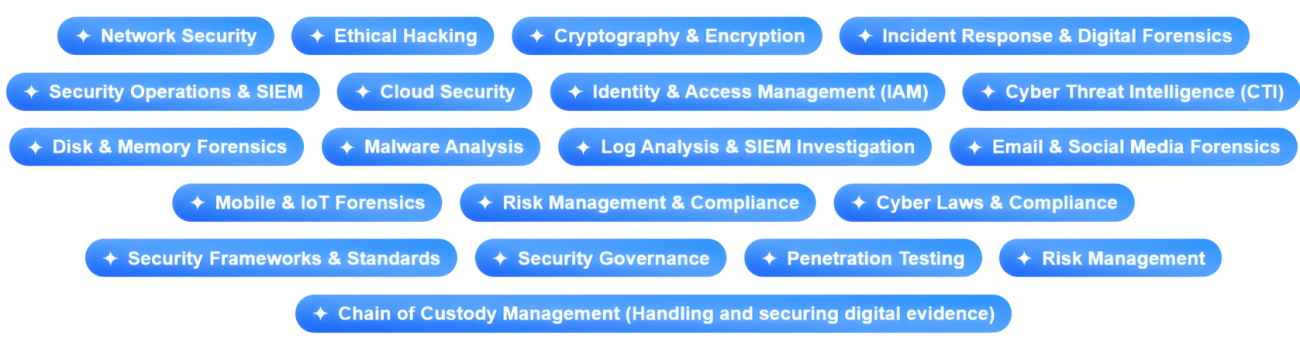
Mastering in Cyber Security & Forensics Skills Covered
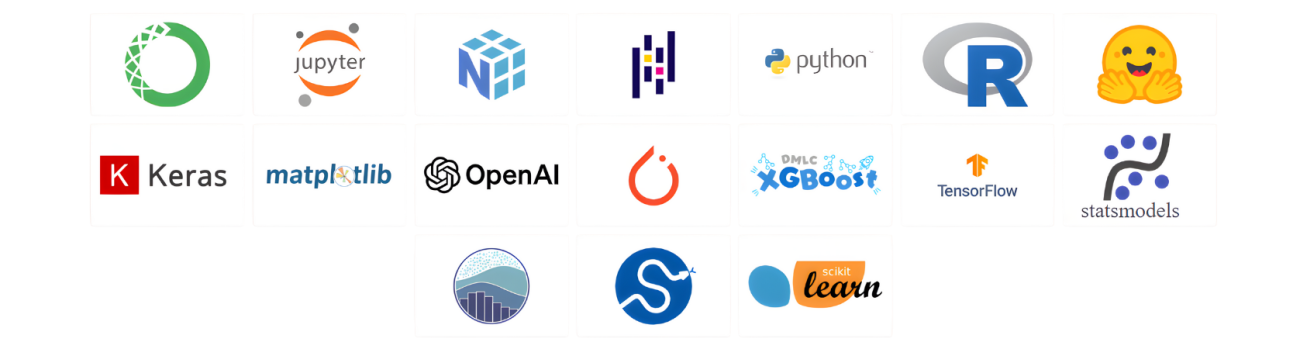
Mastering in Cyber Security & Forensics Tools Covered
Mastering in Cyber Security & Forensics Program Benefits

Cutting-Edge Technologies

In-Demand Skills to tackle real-world cybersecurity threats.

Practical Knowledge

Practical Exposure through hands-on labs and simulations.

Industry Readiness

Industry Certification Readiness to boost credibility and career prospects.

Career Advancement

Career Growth Opportunities in high-paying cybersecurity roles.

Expert Support

Expert Mentorship from industry professionals.

Networking Opportunities

Networking Opportunities with peers and cybersecurity experts.

Flexible Learning

Flexible Learning tailored for working professionals.

Admission Process

The application process consists of three simple steps. An offer of admission will be made to selected candidates based on the feedback from the interview panel. The selected candidates will be notified over email and phone, and they can block their seats through the payment of the admission fee.