Generative AI  /  Beginner to Mastery

Data Science With Business

Intelligence Course

Course Duration

375 Hours


Course Material

Live. Online. Interactive.

Facilitates networking opportunities with professionals and peers.

Includes real-time feedback and support from experienced instructors.

Prepares for a range of roles in data science with business intelligence.

Provides hands-on experience through industry projects and case studies for practical learning.

KEY HIGHLIGHTS OF DATA SCIENCE WITH BUSINESS INTELLIGENCE COURSE PROGRAM

1) 25 + live session Across 4 month

2) 75 Hours of Self Paced Learning

3) Weekly sessions with industry professionals

4) Dedicated Learning Management Team

5) 240 hours of hands-on learning experience

6) 75+ Live Sessions Across 11 months

7) Competitive Edge and Innovation

8) Problem-Solving and Critical Thinking

🔺105 Hours of Self-Paced Learning

🔺More than 25+ industry-related projects and case studies

🔺24*7 Support

🔺1:1 Mock Interview

🔺Designed for both working professionals and fresh graduates

🔺 Learn from Industry Experts.

🔺One-on-One with Industry Mentors

🔺Dedicated Learning Management Team

🔺No-Cost EMI Option

🔺High Demand and Career Opportunities

                                          WHY JOIN APPLIED DATA SCIENCE WITH PYTHON PROGRAM?

High Demand

Skills in Python, data analysis, and machine learning are highly sought after and lead to well-paying careers in tech, finance, and healthcare.

Versatility and Practical Application

This program’s skills offer flexibility, allowing you to excel in roles like data analyst, software developer, or AI researcher.

Competitive Edge and Innovation

Learning these tools gives you a competitive edge, sharpens analytical skills, and enables innovation in AI and intelligent systems.

Problem-Solving and Critical Thinking

It sharpens problem-solving and critical thinking by using statistics and machine learning for data-driven decision-making.

Applied Data Science with Python OVERVIEW

This program is designed to equip students with the fundamentals required in data science, as it has become one of the most promising fields nowadays. Learning Python programming helps to learn how data can be manipulated, analysed, and visualised using the same program. Knowing the statistics, you can use it to see how things stack up, what inferences you could derive from them, and base your decisions on data as opposed to gut. From there, the curriculum reaches out to machine learning and deep learning so that students can equip intelligent systems capable of predicting from data. About the course, This extensive program caters to prospective data scientists, analysts, and machine learning engineers in exploring their abilities and assisting them derive meaningful information from diverse datasets..

ENROLL NOW, BOOK YOUR SEAT & AVAIL UPTO 30% FEE WAIVER

Applied Data Science with Python Objectives

This course assures students that they will be competent in Python programming including Deep Learning, Machine Learning, and Statistics. Firstly, this will start with Python Programming where the student must learn how to write codes effectively as well as become conversant with libraries and frameworks for data analysis as well as scientific computing. The statistical segment of this program will also help them learn more about data distribution, probability theory, hypothesis testing, and regression analysis on which to base their factual decision-making. They should be ready now to understand machine learning such as supervised and unsupervised learning methods; model evaluation; and feature engineering so that they can build predictive models to identify patterns within complex datasets. This is followed by deep learning in neural networks such as convolutional or recurrent neural networks and their applications in image recognition and speech recognition among others. By the end of the course, the learners are expected to implement a Data Science project from scratch until it is designed according to contemporary practices thus converting raw information into action-oriented results.

Why Learn Advanced AI & Generative AI ?

Master Essential Tools

Learn Python programming, data manipulation in Pandas and NumPy, and statistical analysis tools to explore the dataset and derive insights from it.

Build Predictive Models

Making machines helping to make decisions and predictions using Machine Learning & Deep learning techniques.

Unlock Data Potential

Discover hidden patterns and insights within your data through data analysis and feature engineering, driving informed decision-making.

Enhance Communication

Innovative ways of communicating detailed understanding and findings with data visualisation techniques.

Advance Your Career

Gain skills that can lead you to top jobs in data science, machine learning, and artificial intelligence.

Drive Innovation

Develop cutting-edge technologies and solutions with deep understanding of these tools.

Hands-On Learning

Work on real-world projects and case studies to apply concepts practically and build a strong portfolio.

Problem-Solving Mindset

Develop analytical and critical thinking skills to tackle complex business and research challenges using data-driven approaches.

Program Advantages

✅ Covers Python, statistical analysis, machine learning, and deep learning for a broad data science foundation.

✅ Focuses on current tools and practices to ensure up-to-date training.

✅ Combines theory with projects for hands-on problem-solving skills.

✅ Taught by knowledgeable educators with a focus on individual student attention.

✅ Prepares students for roles like Data Analysts, Machine Learning Engineers, and AI Specialists.

✅ Teaches state-of-the-art libraries and frameworks such as TensorFlow and Keras.

✅ Encourages teamwork, idea sharing, and networking among students.

✅ Helps students build a professional portfolio for job searches and promotions.

✅ Provides a solid foundation for continuous learning in evolving data science technologies.

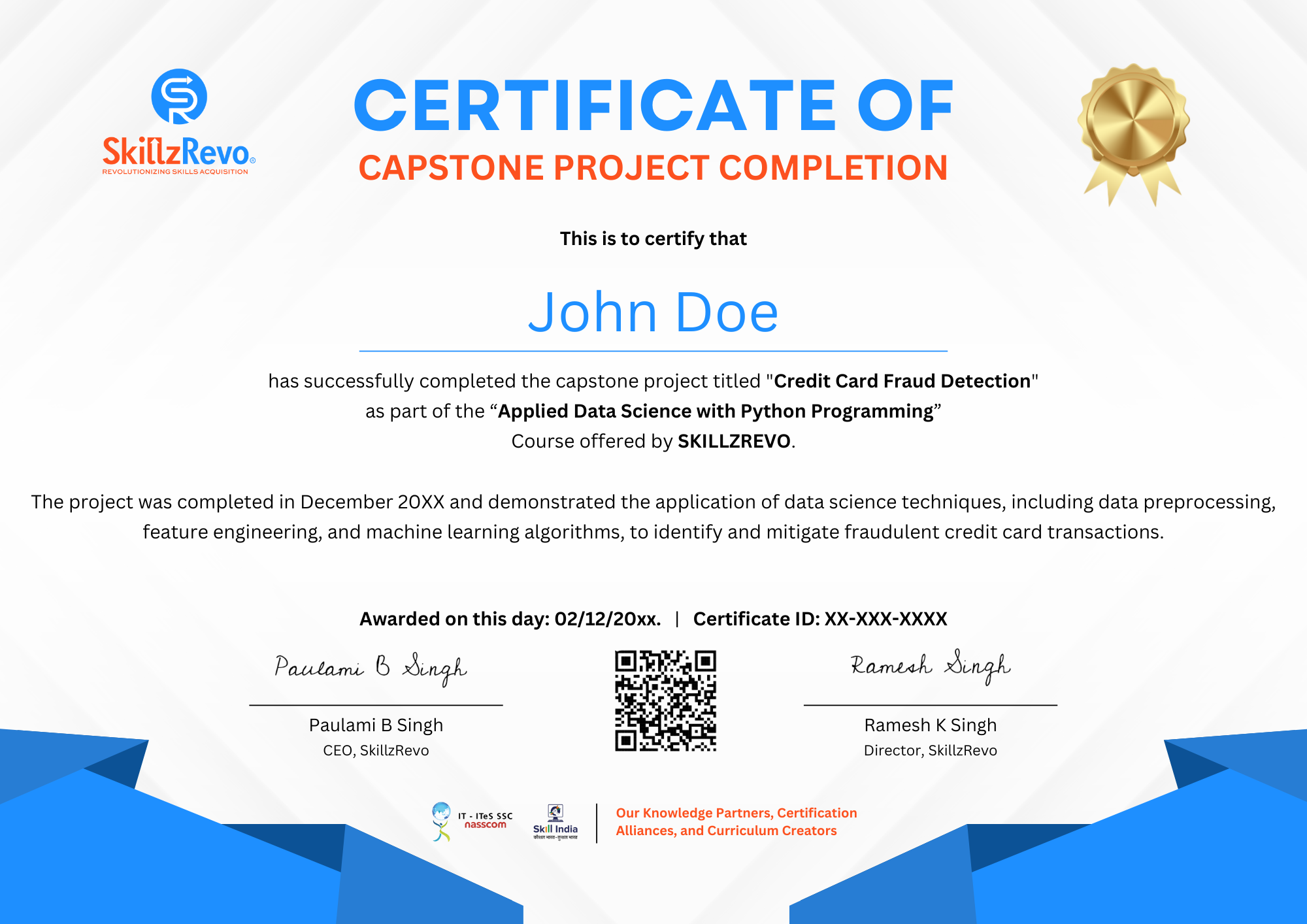
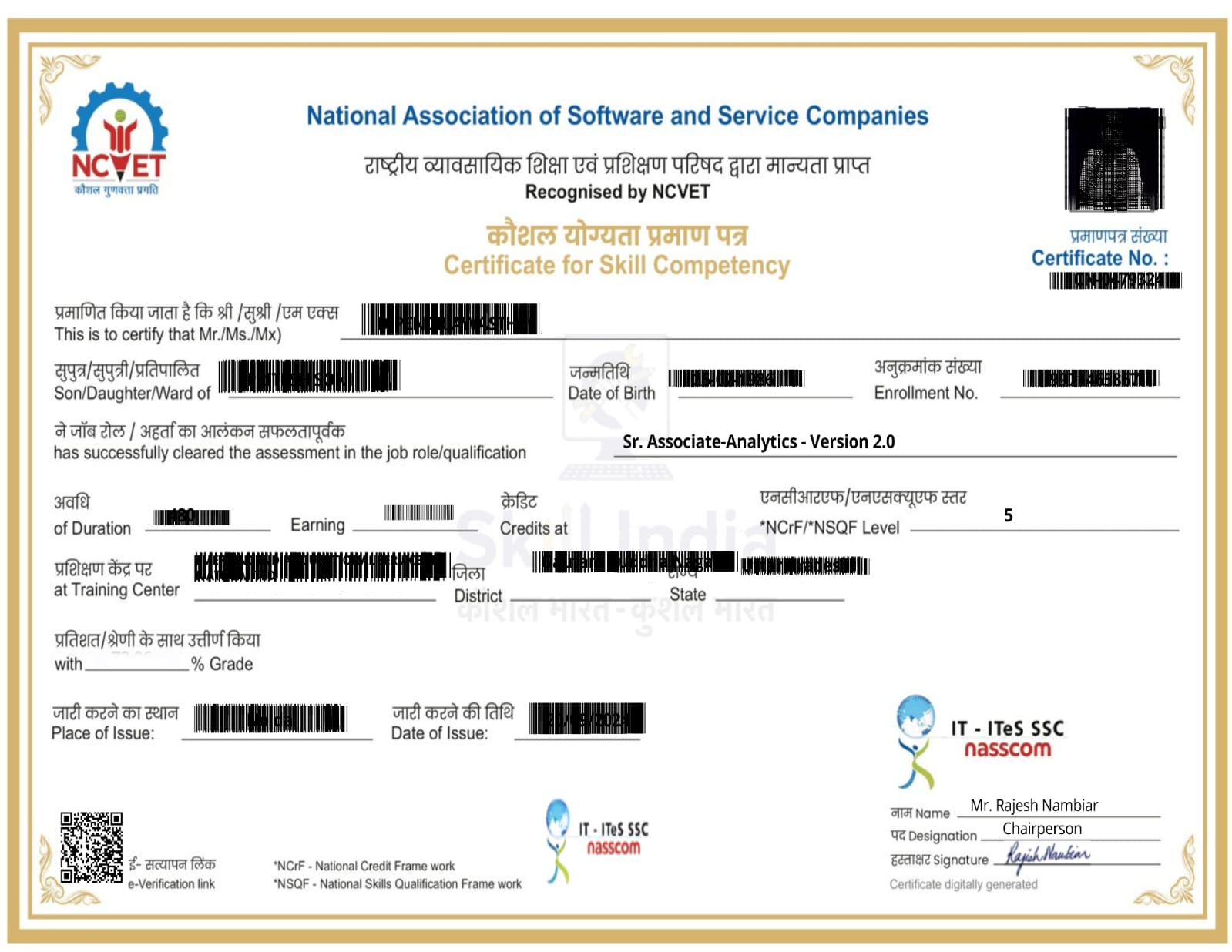
Applied Data Science with Python program Certifications
Applied Data Science with Python Curriculum

Module 01 - Python
Lecture 01: Introduction to Python
Lecture 02: Operators and Conditional Statements
Lecture 03: Lambda Functions, *args, **kwargs, Functions
Lecture 04: Data Structures – List, Tuple, and List Comprehensions
Lecture 05: Data Structures – Set and Dictionaries
Lecture 06: Classes, Objects and Constructors, Inheritance
Lecture 07: Polymorphism, Abstraction and Encapsulation
Lecture 08: Connecting to Databases
Lecture 09: Introduction to Numpy and Pandas
Lecture 10: Introduction to Seaborn and Matplotlib
Module 02 - Statistics
Lecture 11: Introduction to Statistics, Descriptive Statistics, Sample, Population, Major of Central Tendency, Standard Deviation,
Lecture 12: Variance, Range, IQR, Outliers, Correlation, Covariance Skewness, Kurtosis, Probability
Lecture 13: Probability, Probability distributions, Central Limit Theorem, Binomial and Poisson Distribution
Lecture 14: Normal Distribution, Type I & Type II Error
Lecture 15: T-test, Z-test, Hypothesis Testing
Interview Questions


Module 03 - Machine Learning
Lecture 16: Introduction to ML, Types of variables, Encoding, Normalization, Standardization, Types of ML, Linear Regression
Lecture 17: Linear Regression, Logistic Regression, SVM, KNN, Naïve Bayes, Decision Tree, Random Forest
Lecture 18: Mean Absolute Error, Mean and Root Mean Square Error, Confusion Matrix, R2 Score, Adjusted R2 Score,F1 Score
Lecture 19: Classification Report, AUC ROC, Accuracy, Ensemble Techniques, Random Forest, Xgboost
Lecture 20: Unsupervised Machine Learning, PCA, Clustering, k-Means Clustering and Hierarchical clustering
Module 04 - Deep Learning
Lecture 21: Introduction to Neural Network, Foreward Propagation, Activation Function
Lecture 22: Activation Function(Linear, Sigmoid, Relu, Leaky Relu), Optimizers, Gradient Descent, Stochastics Gradient Descent
Lecture 23: Mini batch Gradient Descent, Adagrad, Padding, Pooling, Convolution, Checkpoints and Neural Networks Implementation
Lecture 24: Introduction to Time Series Analysis, Various components of the TSA, Decomposition Method (Additive Method and Multiplicative)
Lecture 25: ARMA and ARIMA
Lecture 26: Project Session

Applied Data Science with Python Skills Covered

Applied Data Science with Python Tools Covered

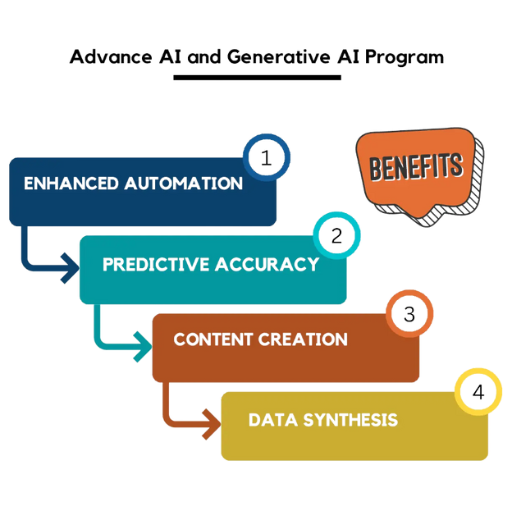
Applied Data Science with Python Program Benefits
Innovative Problem-Solving
Enhance your ability to design and create cutting-edge AI applications.
Future Of Your Career
Unlock well paying high-demand jobs in the AI and tech industry.


Real-world Applications
Solve challenging problems in all competitive coding related domains.


Breadth of Skills
Develop skills in programming, data analysis and AI methods across the board.


Innovative Problem-Solving
Enhance your ability to design and create cutting-edge AI applications.


Earn Certification
Earn a certification that validates your expertise and enhances your professional credibility.


Advanced AI & Generative AI Program Benefits

The application process consists of three simple steps. An offer of admission will be made to selected candidates based on the feedback from the interview panel. The selected candidates will be notified over email and phone, and they can block their seats through the payment of the admission fee.