Generative AI  /  Beginner to Mastery

Data Science With Business Intelligence Course

Course Duration

375 Hours


Course Material

Live. Online. Interactive.

Facilitates networking opportunities with professionals and peers.

Includes real-time feedback and support from experienced instructors.

Prepares for a range of roles in data science with business intelligence.

Provides hands-on experience through industry projects and case studies for practical learning.

KEY HIGHLIGHTS OF DATA SCIENCE WITH BUSINESS INTELLIGENCE COURSE PROGRAM

1) Weekly sessions with industry professionals

2) Dedicated Learning Management Team

3) 375 hours of hands-on learning experience

4) Over 120 hours live sessions spread across 05 months

5) 160 hours of self-paced Learning

6) Learn from Industry Experts.

🔺Competitive Edge and Innovation

🔺More than 35+ industry-related projects and case studies

🔺24*7 Support

🔺1:1 Mock Interview

🔺Designed for both working professionals and fresh graduates

🔺 Problem-Solving and Critical Thinking

🔺One-on-One with Industry Mentors

🔺Dedicated Learning Management Team

🔺No-Cost EMI Option

🔺High Demand and Career Opportunities

WHY JOIN DATA SCIENCE WITH BUSINESS INTELLIGENCE COURSE PROGRAM?

Expert Instruction

Learn from experienced instructors who bring real-world insights and practical knowledge to the program.

Flexible Learning Options

Benefit from flexible learning formats that cater to different schedules and learning preferences, including online and in-person options.

Certification

Earn a certification upon completion that validates your skills and knowledge, enhancing your professional credentials.

Increased Earning Potential

Improve your earning potential with specialized skills in data science and business intelligence, fields known for lucrative opportunities.

Data Science With Business Intelligence Course OVERVIEW

This Program provides a practical curriculum tailored to impart necessary skills in data analysis and visualization among-st the professionals. The program covers the fundamentals of data science and provides hands-on experience with Python for data manipulation and analysis. The ways to interpret and decide the data is very vast hence learn advanced statistical techniques for this. The learners will get hands-on experience in machine learning and deep learning for predictive modeling. It teaches how to manage data through database management, creating visualizations it covers from Power BI and Tableau to working advanced visualization Tables on these Tools. In the end, our comprehensive approach helps students tie it all together so they can apply data-informed insights meaningfully, and make strategic business decisions.

ENROLL NOW, BOOK YOUR SEAT & AVAIL UPTO 30% FEE WAIVER

Data Science With Business Intelligence Course Objectives

This Program is to impart participants with insights into data analysis, interpretation and visualization for effective decision-making. As part of this course, you will learn some basics as well as sophisticated tools like Python programming, Data Analysis with Statistics and Machine Learning & Deep Learning for both beginners to advanced level. The diversification in the subjects ranges from SQL & Data Visualization softwares such as Tableau, and Power BI etc,. Graduates of the program will learn how to leverage data-driven insights, advanced analytical methods and compelling visualizations that drive strategic business decisions.

Why Learn Data Science With Business Intelligence Course ?

High Demand for Skills

Data science and business intelligence are among the most sought-after skills in today’s job market, offering vast career opportunities across various industries.

Data-Driven Decision Making

Learn to harness the power of data to drive strategic decisions, improving business outcomes and competitiveness.

Comprehensive Skill Set

Gain proficiency in a range of essential tools and techniques, including Python, SQL, machine learning, deep learning, Tableau, and Power BI, making you a versatile professional.

Advanced Analytical Capabilities

Develop advanced analytical skills to interpret complex data sets, identify patterns, and make predictions, enabling more effective problem-solving.

Bridging Business and Technology

Gain the ability to translate complex data insights into actionable business strategies, bridging the gap between technical teams and decision-makers.

Future-Proof Career Path

As organizations increasingly adopt AI and data-driven solutions, these skills ensure long-term relevance and stability in a rapidly evolving job market.

Enhanced Career Prospects

This course equips you with the expertise to pursue roles such as Data Analyst, Data Scientist, Business Intelligence Analyst, and more, with potential for career advancement.

Practical, Hands-On Learning

Engage in hands-on projects and real-world case studies, ensuring that you can apply what you learn directly to your professional environment.

Program Advantages

✅ Covers the entire data science and business intelligence pipeline, from data collection and analysis to visualization and strategic decision-making.

✅ Gain in-depth knowledge of Python, the leading programming language for data science, allowing you to perform data manipulation, analysis, and automation efficiently.

✅ Build a solid understanding of statistics, enabling you to make data-driven decisions and apply advanced statistical methods in real-world scenarios.

✅ Learn cutting-edge techniques in machine learning and deep learning to build predictive models and AI-driven solutions.

✅ Develop robust SQL skills, essential for querying and managing large datasets, ensuring you can handle data efficiently in any database environment.

✅ Master Tableau and Power BI to create dynamic and interactive data visualizations, making complex data insights accessible and actionable.

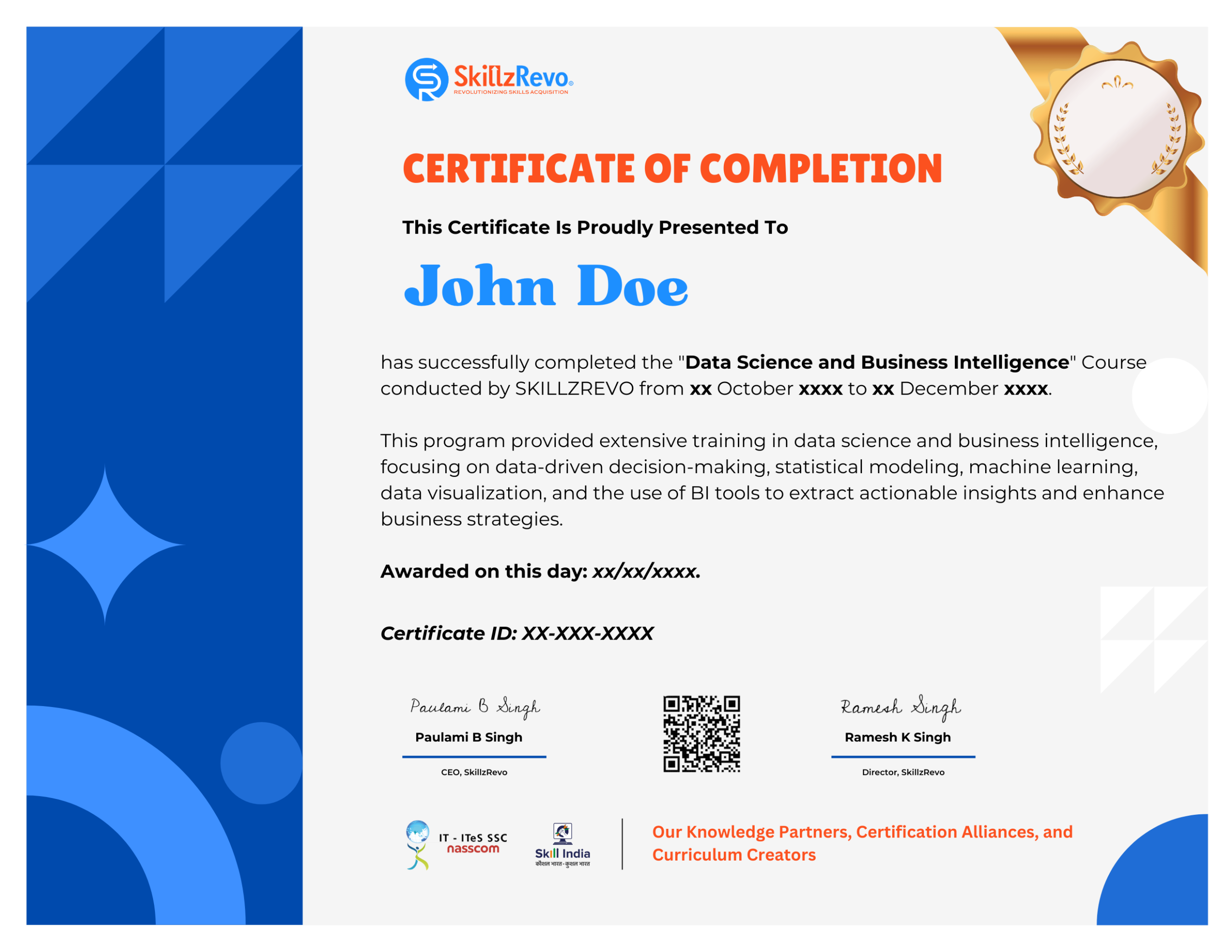
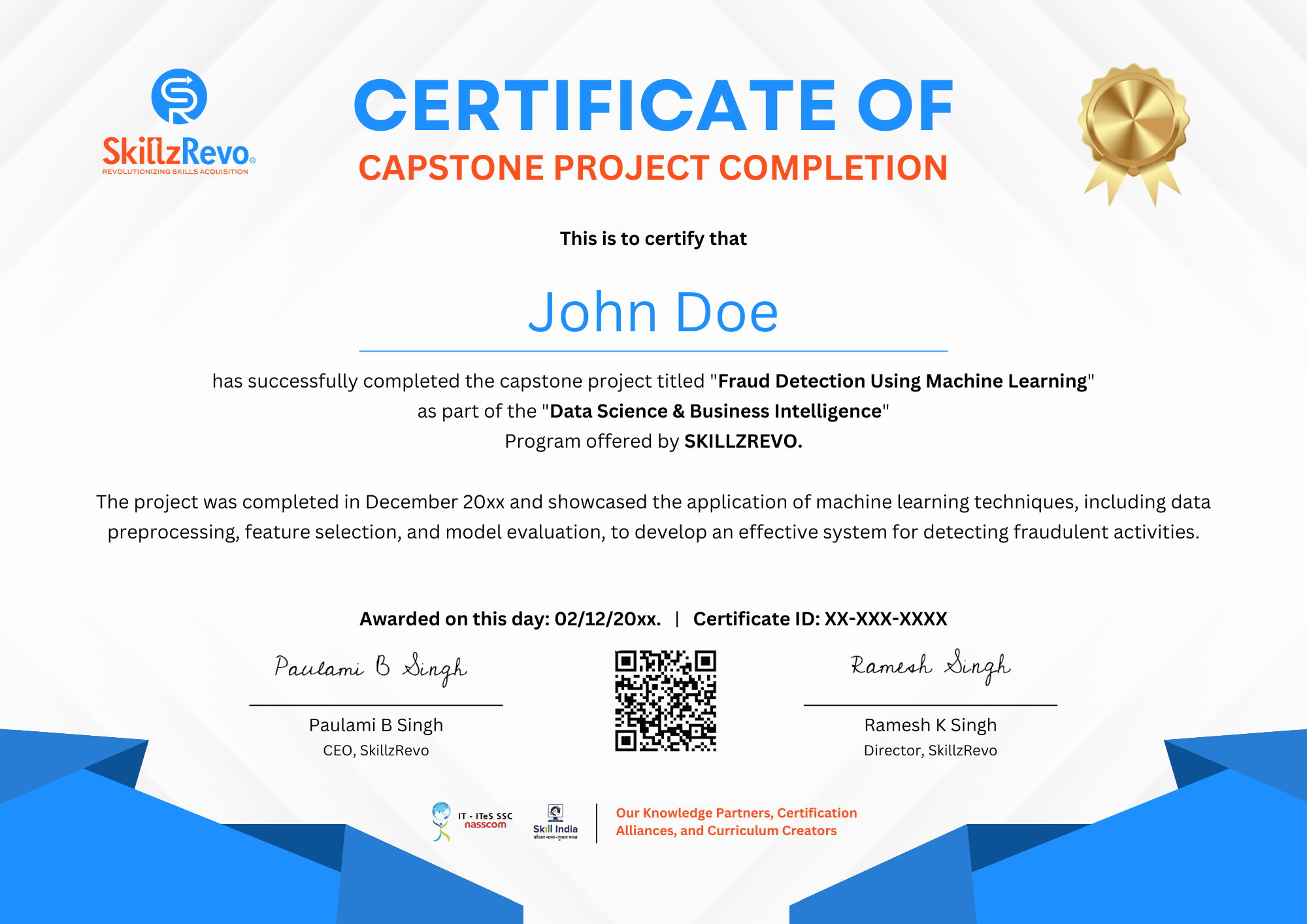
Data Science With Business Intelligence Course program Certifications

Data Science With Business Intelligence Course Curriculum

Module 01 - Python
Lecture 01: Introduction to Python, Why Python, Variables, Data Types, Type Casting, Strings, Indexing
Lecture 02: Operators and Conditional Statements, Looping Statements and its Control Statement
Lecture 03: Lambda Functions, *args, **kwargs, Functions
Lecture 04: Data Structures – List, Tuple, and List Comprehensions
Lecture 05: Data Structures – Set and Dictionaries
Lecture 06: Classes, Objects and Constructors, Inheritance
Lecture 07: Polymorphism, Abstraction and Encapsulation
Lecture 08: Connecting to Databases, Establishing Connections to Databases, Executing SQL Queries, ORM (Object-Relational Mapping), Working with NoSQL Databases
Lecture 09: Introduction to Numpy and Pandas
Lecture 10: Introduction to Seaborn and Matplotlib
Module 02 - Statistics
Lecture 11: Introduction to Statistics, Descriptive Statistics, Sample, Population, Major of Central Tendency, Standard Deviation,
Lecture 12: Variance, Range, IQR, Outliers, Correlation, Covariance Skewness, Kurtosis, Probability
Lecture 13: Probability, Probability distributions, Central Limit Theorem, Binomial and Poisson Distribution
Lecture 14: Normal Distribution, Type I & Type II Error
Lecture 15: T-test, Z-test, Hypothesis Testing
Interview Questions
Module 03 - Machine Learning
Lecture 16: Introduction to ML, Types of variables, Encoding, Normalization, Standardization, Types of ML, Linear Regression
Lecture 17: Linear Regression, Logistic Regression, SVM, KNN, Naïve Bayes, Decision Tree, Random Forest
Lecture 18: Mean Absolute Error, Mean and Root Mean Square Error, Confusion Matrix, R2 Score, Adjusted R2 Score,F1 Score
Lecture 19: Classification Report, AUC ROC, Accuracy, Ensemble Techniques, Random Forest, Xgboost
Lecture 20: Unsupervised Machine Learning, PCA, Clustering, k-Means Clustering and Hierarchical clustering
Module 05 - SQL
Lecture 27: Basics of Database, Types of Database, Data Types, SQL Operators, Expressions, Create, Insert
Lecture 28: Drop, Truncate, Delete, Alter, Update, Select, Range, Operator, IN, Wildcard, Like, Clause
Lecture 29: Constraint, Aggregation Function, Group By, Order By, Having
Lecture 30: Classification Report, AUC ROC, Accuracy, Ensemble Techniques, Random Forest, Xgboost
Lecture 31: Joins, Case, Complex Queries, Doubt Clearing
Module 06 - Tableau
Lecture 32: Tableau Desktop, Tableau Products
Lecture 33: Data Import, Measures, Filters
Lecture 34: Data Transformation, Marks, Dual Axis
Lecture 35: Manage Worksheets, Data Visualization, Dashboarding
Lecture 36: Project Session
Module 07 - Power BI
Lecture 37: Power BI Platform, Process Flow
Lecture 38: Features, Dataset, Bins
Lecture 39: Pivoting, Query Group, DAX Function
Lecture 40: Formula, Charts, Reports, Dashboards
Lecture 41: Bookmarks and Buttons, Conditional Formatting and Sorting, and Report Layout and Interaction
Lecture 42: Tabular Visuals, Modelling and Calculations, Advanced Data Modelling Scenarios and DAX in Power BI

Data Science With Business Intelligence Course Skills Coveredd

Applied Data Science with Python Tools Covered

Applied Data Science with Python Program Benefits
Innovative Problem-Solving
Enhance your ability to design and create cutting-edge AI applications.
Future Of Your Career
Unlock well paying high-demand jobs in the AI and tech industry.


Real-world Applications
Solve challenging problems in all competitive coding related domains.


Breadth of Skills
Develop skills in programming, data analysis and AI methods across the board.


Innovative Problem-Solving
Enhance your ability to design and create cutting-edge AI applications.


Earn Certification
Earn a certification that validates your expertise and enhances your professional credibility.


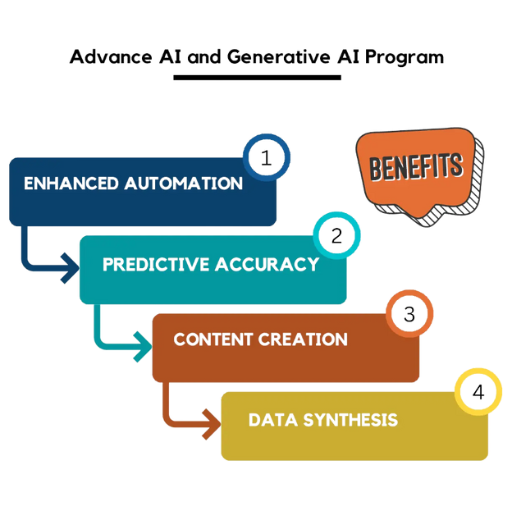
Advanced AI & Generative AI Program Benefits

The application process consists of three simple steps. An offer of admission will be made to selected candidates based on the feedback from the interview panel. The selected candidates will be notified over email and phone, and they can block their seats through the payment of the admission fee.