Generative AI  /  Beginner to Mastery

Certified Forensics Analyst

Course Duration

300 Hours


Course Material

Live. Online. Interactive.

Expert guidance and mentorship for building industry-ready skills.

KEY HIGHLIGHTS OF CERTIFIED FORENSICS ANALYST PROGRAM

1) Weekly sessions with industry professionals

2) Dedicated Learning Management Team

3) 300 hours of hands-on learning experience

4) Learn from Industry Experts.

5) Over 90 hours live sessions spread across 04 months

6) 90 hours of self-paced Learning

🔺More than 10+ industry-related projects and case studies

🔺24*7 Support

🔺1:1 Mock Interview

🔺Designed for both working professionals and fresh graduates

🔺Competitive Edge and Innovation

🔺 One-on-One with Industry Mentors

🔺Dedicated Learning Management Team

🔺No-Cost EMI Option

🔺High Demand and Career Opportunities

🔺Problem-Solving and Critical Thinking

WHY JOIN CERTIFIED FORENSICS ANALYST PROGRAM?

Hands-On Learning

Engage in practical labs and real-world case studies to apply your learning.

Comprehensive Learning

Gain knowledge of digital forensics, covering evidence collection, system forensics, incident response, and legal aspects.

Industry-Relevant Tools

Work with tools like FTK Imager, Volatility, and Cyber Triage, used by professionals in forensics.

Expert Guidance

Learn from instructors with experience in digital forensics, cybersecurity, and incident response.

Certified Forensics Analyst OVERVIEW

This digital forensic program offers a broader and hand learning experience, which equip the participants with the skills and knowledge required to identify, investigate and react to cyber crime and safety events. Along with focusing on various aspects of digital forensic, including evidence collection, system and OS forensic, memory analysis and event reaction-this course provides intensive coverage of equipment, techniques and legal ideas involved in the forensic investigation. Students will get practical experience through attractive projects, which will help them to create proficiency for real -world application.

ENROLL NOW, BOOK YOUR SEAT & AVAIL UPTO 30% FEE WAIVER

Certified Forensics Analyst Objectives

This course is to equip participants with a comprehensive understanding of Digital Forensics, from Foundational Principles to Advanced Investigative Techniques. By the end of the program, Learners will be Proficient in Collecting, Preserving, and Analyzing Digital Evidence from Various Platforms, Including Computers, Mobile Devices, Mobile Devices, Mobile Devices, and Cloud Env. They will also get expertise in the event response, malware analysis and memory forensic using industry-standard equipment. Additionally, the course aims to develop participants’ ability to conduct thorough Forensic Investigations, Prepare Detailed Reports, and Navigate the Legal and Regulatory Aspects of Digital Forensic, Their findings are admissible in court. Overall, the course is designed to Empower Learners to Tackle Real-world Cyber Security challenges and make meaningful contributions to the field of digital forensics.

Why Learn Certified Forensics Analyst ?

MASTER DIGITAL FORENSICS PRINCIPLES

Understand core concepts such as evidence handling, forensic investigation lifecycle, and the methodologies applied in modern forensic practices.

COLLECT AND ANALYZE DIGITAL EVIDENCE

Gain hands-on skills in acquiring and analyzing evidence from diverse systems including Windows, Linux, mobile, memory, and cloud environments.

ADVANCE INCIDENT RESPONSE SKILLS

Learn to conduct incident response and malware analysis, understand attack patterns, and apply effective recovery strategies.

UTILIZE INDUSTRY-LEADING TOOLS

Master forensic tools and techniques to uncover hidden data, trace security breaches, and support legal investigations with accuracy.

DEVELOP PROFESSIONAL FORENSIC REPORTING

Build expertise in creating detailed, clear, and comprehensive forensic reports for both technical experts and non-technical stakeholders.

GAIN REAL-WORLD EXPERIENCE

Work on practical projects and case studies that simulate real cybercrime scenarios, preparing you for industry challenges.

Program Advantages

✅ Practical labs and real-world case studies to apply your learning in a controlled environment.

✅ Learn from seasoned professionals with extensive experience in digital forensics, cybersecurity, and incident response.

✅ Gain hands-on experience with industry-standard tools like FTK Imager, Volatility, Cyber Triage, and more.

✅ Explore a variety of topics such as evidence collection, Windows and Linux forensics, memory analysis, incident response, and cyber law.

✅ Participate in hands-on projects to analyze cyber-attacks, perform malware analysis, and simulate corporate cyber incidents.

✅ A mix of live sessions, recorded materials, and self-paced assignments offers flexible learning.

✅ Understand legal frameworks in digital forensics, including data privacy regulations and the chain of custody.

✅Ensure compliance with global and regional laws regarding digital evidence handling.

Certified Forensics Analyst program Certifications

Certified Forensics Analyst program Curriculum

Module 01 - Introduction to Digital Forensics
Lecture 01: Introduction to Digital Forensics: Definition, history, scope, and key areas of application, Types of Digital Forensics: Computer forensics, Mobile forensics, Network forensics, Memory forensics, & Cloud forensics
Lecture 02: Forensic Investigation Lifecycle and Roles: Phases of forensic investigation, roles and responsibilities of a forensic investigator, and tools overview.
Module 02 - Evidence Collection and Preservation
Lecture 03: Principles of Evidence Handling: Best practices, importance of evidence integrity, contamination prevention, and documentation.
Lecture 04: Imaging Techniques – Part 1: Introduction to disk imaging concepts, bit-by-bit imaging, and types of forensic imaging. Part 2: Practical use of imaging tools and steps to create and verify a forensic image.
Lecture 05: Chain of Custody and Legal Considerations: Importance of chain of custody, documentation practices, admissibility in court, and hash verification for evidence integrity using MD5 and SHA-256.


Module 03 - Cyber Laws and Regulations

Lecture 06: Overview of Cyber Laws: Introduction to cyber laws, importance of data privacy laws, and key global frameworks (e.g., GDPR, HIPAA). Indian cyber laws: IT Act, 2000 (key sections, amendments).


Lecture 07: Digital Evidence Regulations and Case Studies: Admissibility of digital evidence, legal considerations, and analysis of notable Indian and global cybercrime cases.


Module 04 - Cyber Laws and Regulations
Lecture 08:  Evidence Types: Overview of physical, digital, and biological evidence, classification of evidence (direct, indirect, circumstantial), and their relevance in investigations.
Lecture 09: Forensic Best Practices: Importance of documentation, chain of custody, differences between digital and traditional forensics, and integration of both disciplines in investigations.


Module 05 - Windows Forensics
Lecture 10:  Introduction to Windows File Systems: Overview of Windows file systems (FAT, NTFS, exFAT), structure, file allocation tables, and their relevance in forensics. User Activity Analysis: Techniques to analyze user activity (recent files, run commands, etc.), user profiles, and traces left in the Windows OS.Tools: FTK Imager (for disk imaging), Cyber Triage (for initial system analysis).
Lecture 11: Registry Forensics: Understanding the Windows Registry, key locations, user activity tracking, evidence recovery from the Registry. Tools: FTK Imager (for registry extraction), Belkasoft RAM Capturer (for capturing live memory to analyze registry keys in RAM).
Lecture 12: Event Logs: Analyzing Windows Event Logs (Security, Application, System), event log sources, and event timeline construction.Tools: Cyber Triage (for parsing and analyzing event logs), Belkasoft Evidence Center (for advanced event log analysis).
Lecture 13: Deleted File Recovery: Methods to recover deleted files, understanding NTFS file slack, unallocated space, and using tools (e.g., FTK Imager, EnCase) to recover files. Tools: FTK Imager (for carving deleted files), Belkasoft RAM Capturer (for recovering volatile data).
Lecture 14: Application Traces & Hands-on Lab: Investigating traces left by applications (browser history, chat logs, application logs) and a practical lab session analyzing Windows file system images.Tools: Cyber Triage (for analyzing application traces), FTK Imager (for application artifact recovery), Belkasoft Evidence Center (for advanced application analysis).


Module 06 - Linux Forensics
Lecture 15:  Introduction to Linux File Systems (ext3/ext4): Overview of ext3/ext4 file systems, inode structure, and journaling. Forensic relevance for recovering deleted files.File System Structure: Analyzing ext3/ext4 file systems, inodes, and block structure. Recovering orphaned and deleted files.Tools: Guymager(disk imaging), Sleuth Kit, TestDisk.
Lecture 16: Filesystem Metadata & Evidence Recovery: Exploring inode metadata (timestamps, permissions) and recovering deleted files. Tools: Extundelete, Scalpel, Guymager.
Lecture 17: Analyzing Linux System Logs: Examining logs (auth.log, syslog) to track user activity, logins, and suspicious actions.SSH Logs & Cron Jobs: Investigating SSH logs for unauthorized access and analyzing cron jobs for suspicious activity.Tools: Syslog, journalctl, rkhunter, Guymager.
Lecture 18: Linux Anomaly Detection & Scripts: Writing bash scripts to detect anomalies, such as file modifications or unauthorized processes.Tools: Lsof, Netstat, Guymager.
Lecture 19: Web Server Logs: Analyzing web server logs (Apache/Nginx) and correlating with file system artifacts. Network forensics for abnormal file system activities. Tools: Wireshark, Guymager, Apache/Nginx logs.


Module 07 - Memory Forensics
Lecture 20: Introduction to Memory Forensics & Capture: Overview of memory forensics, tools for capturing memory (e.g., WinPMEM, DumpIt), and its importance in investigations.Topics: Memory dump acquisition, types of memory analysis.Tools: WinPMEM, FTKImager
Lecture 21: Analyzing Memory Dumps & Processes: Analyzing memory dumps to identify running processes, system activity, and malicious artifacts. Topics: Process listing, investigating system events in memory. Tools: Volatility.
Lecture 22: Detecting Malware & Recovering Encryption Keys: Using memory forensics to detect malware, analyze rootkits, and recover encryption keys from memory. Topics: Malware detection techniques, tracing encryption keys and passwords. Tools: Volatility, Kaspersky Memory Dump Analyzer.
Module 08 - Incident Response Process
Lecture 23: Incident Response Overview: Definitions, objectives, and importance of IR in cybersecurity. Overview of the 6 IR phases: Preparation, Identification, Containment, Eradication, Recovery, and Lessons Learned.
Lecture 24: Preparation Phase: Setting up incident response policies, playbooks, and tools. Key elements like communication plans, response teams, and proactive measures. Introduction to IR tools like SIEM, SOAR, and ticketing systems.
Lecture 25: Identification and Triage: Recognizing incidents through monitoring, logs, and alerts. Categorizing and prioritizing incidents based on severity. Hands-on practice using Splunk/ELK to analyze alerts and logs for threat identification.
Lecture 26: Containment, Root Cause Analysis (RCA), and Eradication – Immediate damage control, temporary vs. long-term containment. Importance of RCA in understanding the attack origin and vector, RCA with Cyber Triage, malware removal, patching, and hardening.
Lecture 27: Recovery and Lessons Learned: Steps to restore systems and validate their integrity. Developing a ‘lessons learned’ report to improve future responses. Role of forensic investigations in refining IR processes.


Module 09 - Forensic Reporting and Documentation
Lecture 28: Introduction to Forensic Reporting – Objectives, importance of documentation, and key report elements: Executive summary, methodology, findings, and recommendations.
Lecture 29: Structuring Reports for Different Audiences – Writing for legal, managerial, and technical audiences; ensuring clarity, avoiding jargon, and maintaining accuracy.
Lecture 30: Tools & Hands-on Practice – Overview of FTK, Autopsy, reporting templates; automating reports, analyzing sample reports, and hands-on report writing.

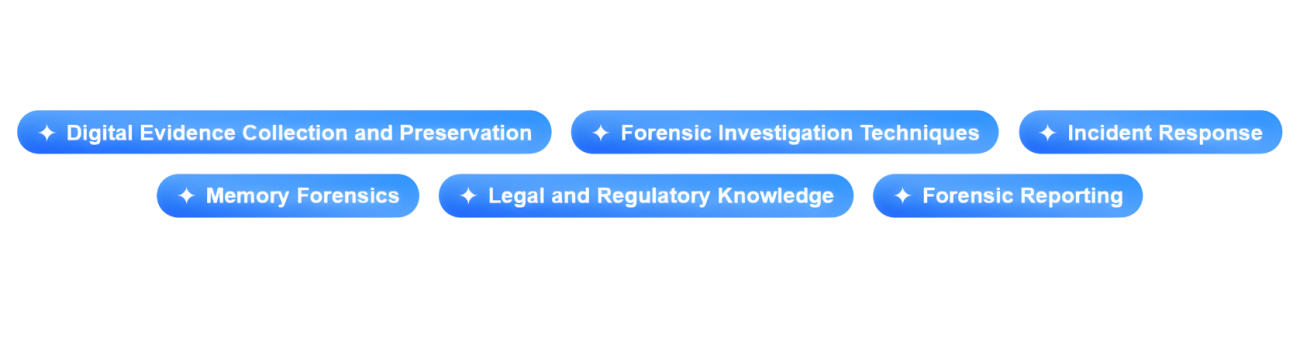
Certified Forensics Analyst Skills Covered
Certified Forensics Analyst Tools Covered

Certified Forensics Analyst Program Benefits

Comprehensive Learning

Gain an in-depth understanding of digital forensics, covering evidence collection, system forensics, memory analysis, incident response, and cyber law.

Hands-on Experience

Apply your knowledge through practical labs, real-world case studies, and more than 10+ industry-related projects and simulations.

Industry-Relevant Tools

Get hands-on training with leading forensic tools such as FTK Imager, Volatility, Cyber Triage, Belkasoft, and Wireshark.

Expert Guidance

Learn from IIT faculty, seasoned professionals, and industry experts with extensive experience in digital forensics and cybersecurity.

Career Advancement

Open doors to diverse roles such as Digital Forensic Analyst, Incident Response Specialist, Cybersecurity Analyst, and Forensic Consultant.

Flexible Learning

Access a blend of live sessions, recorded content, and self-paced assignments, designed to suit both working professionals and fresh graduates.

Admission Process

The application process consists of three simple steps. An offer of admission will be made to selected candidates based on the feedback from the interview panel. The selected candidates will be notified over email and phone, and they can block their seats through the payment of the admission fee.