Generative AI  /  Beginner to Mastery

Applied Data Science with AI

Course Duration

300 Hours


Course Material

Live. Online. Interactive.

Flexible learning paths

Globally recognized certification

Career support and networking opportunities

Strong emphasis on practical skills and innovation

KEY HIGHLIGHTS OF APPLIED DATA SCIENCE WITH AI PROGRAM

1) Weekly sessions with industry professionals

2) Dedicated Learning Management Team

3) 300 hours of hands-on learning experience

4) Over 105 hours live sessions spread across 11 months

5) 105 hours of self-paced Learning

6) Learn from IIT Faculty & Industry experts

🔺More than 40+ industry-related projects and case studies

🔺24*7 Support

🔺1:1 Mock Interview

🔺Designed for both working professionals and fresh graduates

🔺Competitive Edge and Innovation

🔺 Personalised mentorship sessions with industry experts

🔺Dedicated Learning Management Team

🔺No-Cost EMI Option

🔺High Demand and Career Opportunities

🔺Problem-Solving and Critical Thinking

WHY JOIN APPLIED DATA SCIENCE WITH AI PROGRAM?

Hands-On Learning

Learn to lead high-demand careers in data analysis, Machine Learning and AI not limited by industry inclination.

Comprehensive Data Science with AI Training

Gain expertise across all major aspects of artificial intelligence and machine learning.

Hands-On Learning

Work on projects which develop real-world skills and experience.

Industry-Relevant Curriculum

Get trained about the latest tools and tricks that are currently trending in Industry.

Applied Data Science with AI OVERVIEW

This Program provides a structured path through the world of artificial intelligence, beginning with Python programming skills and basic statistics. With this bundle, you’ll delve into machine learning, deep learning, computer vision and natural language processing to acquire the tools of this trade. The program also covers reinforcement learning, equipping you to develop AI solutions that learn from interactions. By the end, you’ll have a strong foundation to apply AI technologies in real-world scenarios.

ENROLL NOW, BOOK YOUR SEAT & AVAIL UPTO 30% FEE WAIVER

Applied Data Science with AI Objectives

This course aims to provide a comprehensive understanding of key AI and ML principles. You will start from Python Programming then go on to statistical methods for data analysis. It enables you to have hands-on experience of machine learning algorithms and go deep for computer vision, natural language processing etc. You will also learn about reinforcement learning which is a subcategory of machine learning that examines how AI agents may improve by just carrying out some actions. It sounds like a lot, but by bringing all of these elements together the course is designed to help you solve hard problems and do serious innovation in AI

                                             Why Learn Applied Data Science with AI ?

MASTER ESSENTIAL TOOLS

Gain proficiency in Python programming, statistical analysis, and data visualisation to effectively explore and understand data.

BUILD PREDICTIVE MODELS

Learn machine learning and deep learning techniques to create intelligent systems capable of making accurate predictions and decisions.

UNLOCK DATA POTENTIAL

Discover hidden patterns and insights within your data through data analysis and feature engineering, driving informed decision-making.

EXPLORE DEEP LEARNING

Design and optimise neural networks for advanced tasks like computer vision and natural language processing.

TAKE REINFORCEMENT LEARNING

Discover how AI agents learn at an intuitive level by interacting with their environment and improving over time.

REAL-WORLD IMPACT

Apply your know-how to craft solutions for critical problems at the heart of AI.

BE READY FOR INDUSTRY REQUIREMENTS

Learn the most popular skills required to get a job in one of the fastest growing fields, AI.

ENHANCE COMMUNICATION

Effectively convey complex information and findings using data visualisation techniques.

Program Advantages

✅ Comprehensive skill set in Python programming, statistical analysis, machine learning, deep learning, computer vision, NLP and Reinforcement learning.

✅ Industry-relevant knowledge with a focus on current tools and approaches.

✅ Practical experience through projects and assignments.

✅ Expert instruction from knowledgeable educators.

✅ Familiarity with the latest libraries and frameworks.

✅ Development of critical thinking and problem-solving abilities.

✅ Career advancement opportunities include various roles such as Data Analyst, ML Engineer, Deep Learning Engineer, Computer Vision Engineer, NLP Engineer, Data Scientist, AI Engineer and AI specialist.

✅ A collaborative classroom environment that encourages teamwork and relationship-building.

✅ Create a portfolio for employers to see skills.

✅ Foundation for continued learning in an evolving world of Data Science and AI.

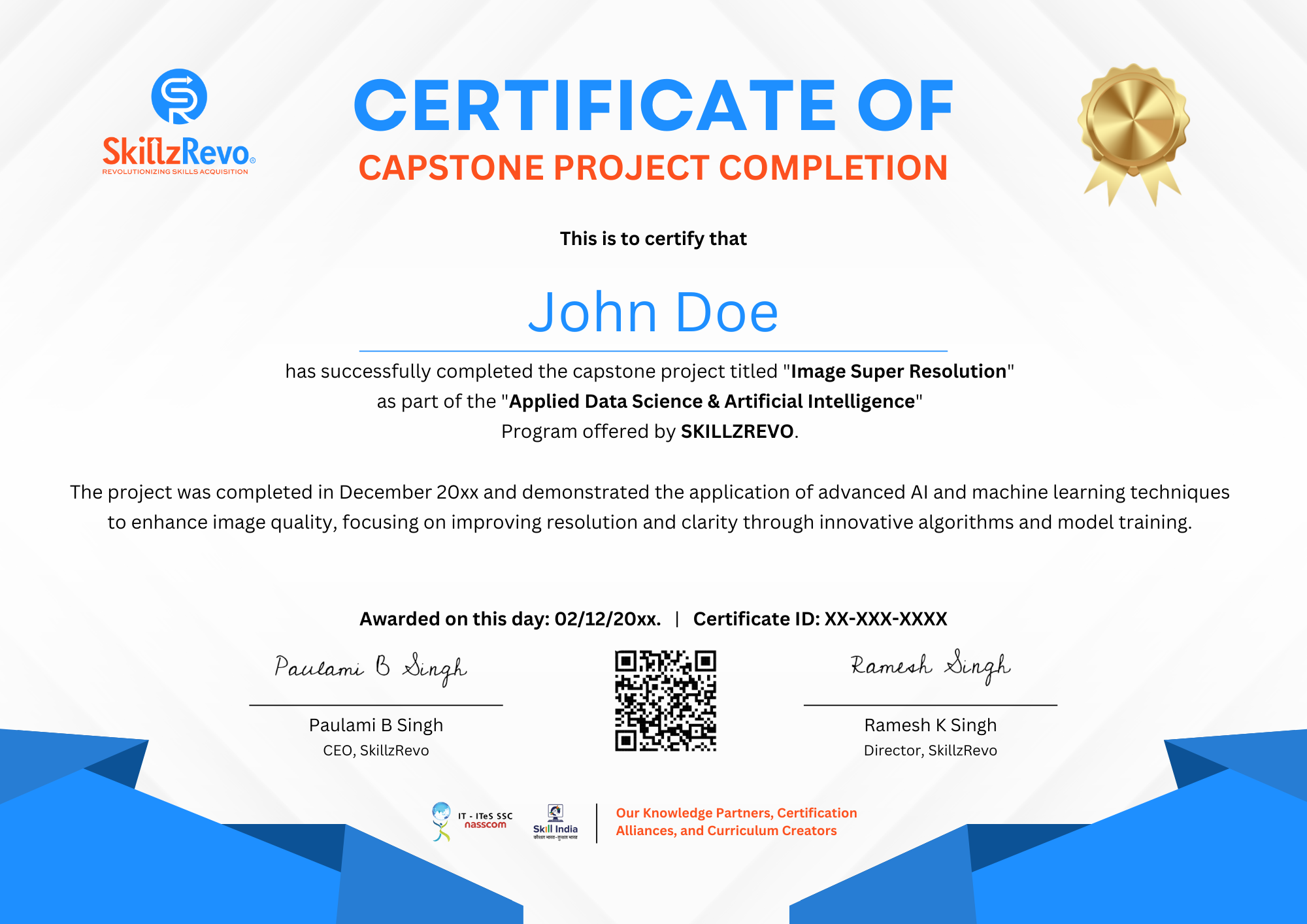
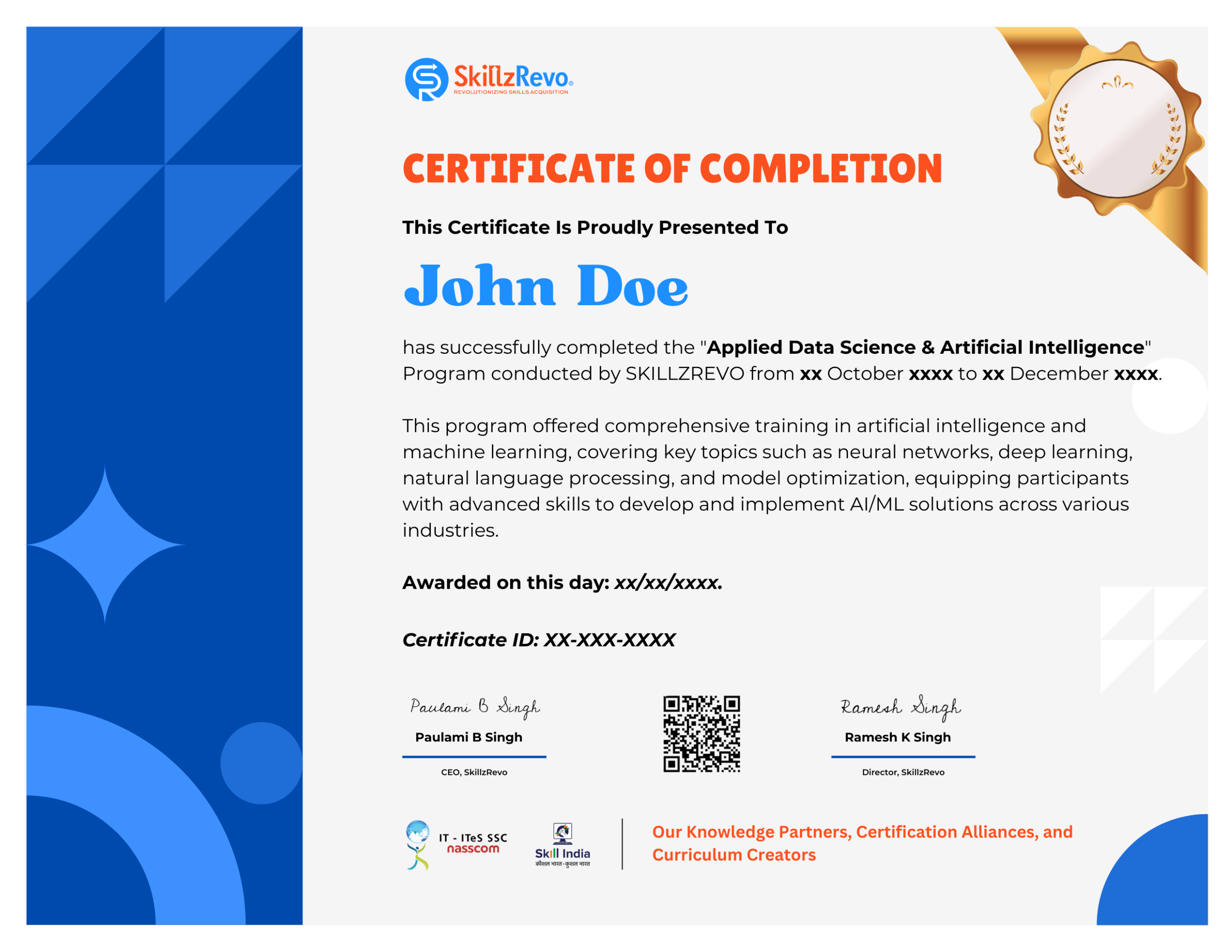
Applied Data Science with AI program Certifications

Applied Data Science with AI Curriculum

Module 01 - Python
Lecture 01: Introduction to Python, Why Python, Variables, Data Types, Type Casting, Strings, Indexing
Lecture 02: Operators and Conditional Statements, Looping Statements and its Control Statement
Lecture 03: Lambda Functions, *args, **kwargs, Functions
Lecture 04: Data Structures – List, Tuple and List Comprehensions
Lecture 05: Data Structures – Set and Dictionaries
Lecture 06: Classes, Objects and Constructors, Inheritance
Lecture 07: Polymorphism, Abstraction and Encapsulation
Lecture 08: Connecting to Databases, Establishing connections to databases, Executing SQL Queries, ORM (Object-Relational Mapping), Working with NoSQL Databases
Lecture 09: Introduction to Numpy and Pandas
Lecture 10: Introduction to Seaborn and Matplotlib
Module 02 - Statistics
Lecture 11: Introduction to Statistics, Descriptive Statistics, Sample, Population, Measures of Central Tendency, Standard Deviation
Lecture 12: Variance, Range, IQR, Outliers, Correlation, Covariance, Skewness, Kurtosis, Probability
Lecture 13: Probability, Probability Distributions, Central Limit Theorem, Binomial and Poisson Distribution
Lecture 14: Normal Distribution, Type I & Type II Error
Lecture 15: T-test, Z-test, Hypothesis Testing Interview Questions
Module 03 - Machine Learning
Lecture 16: Introduction to ML, Types of Variables, Encoding, Normalization, Standardization, Types of ML, Linear Regression
Lecture 17: Linear Regression, Logistic Regression, SVM, KNN, Naïve Bayes, Decision Tree, Random Forest
Lecture 18: Mean Absolute Error, Mean and Root Mean Square Error, Confusion Matrix, R² Score, Adjusted R² Score, F1 Score
Lecture 19: Classification Report, AUC ROC, Accuracy, Ensemble Techniques, Random Forest, XGBoost
Lecture 20: Unsupervised Machine Learning, PCA, Clustering, k-Means Clustering and Hierarchical Clustering
Module 04 - Deep Learning
Lecture 21: Introduction to Neural Network, Forward Propagation, Activation Function
Lecture 22: Activation Functions (Linear, Sigmoid, ReLU, Leaky ReLU), Optimizers, Gradient Descent, Stochastic Gradient Descent
Lecture 23: Mini Batch Gradient Descent, Adagrad, Padding, Pooling, Convolution, Checkpoints and Neural Networks Implementation
Lecture 24: Introduction to Time Series Analysis, Various Components of the TSA, Decomposition Method (Additive Method and Multiplicative)
Lecture 25: ARMA and ARIMA
Module 05 - Computer Vision
Lecture 26: Introduction to Image Processing, Feature Detection, OpenCV
Lecture 27: Convolution, Padding, Pooling & its Mechanisms
Lecture 28: Forward Propagation & Backward Propagation for CNN
Lecture 29: CNN Architectures like AlexNet, VGGNet, InceptionNet, ResNet, Transfer Learning
Module 06 - NLP
Lecture 30: Introduction to Text Mining, Text Processing using Python and Introduction to NLTK
Lecture 31: Sentiment Analysis, Topic Modeling (LDA) and Named-Entity Recognition
Lecture 32: BERT (Bidirectional Encoder Representations from Transformers), Text Segmentation, Text Mining, Text Classification
Lecture 33: Automatic Speech Recognition, Introduction to Web Scraping
Module 07 - Reinforcement Learning (RL)
Lecture 34: RL Framework, Components of RL Framework, Examples of Systems
Lecture 35: Types of RL Systems, Q-Learning
Lecture 36: Project Session

Applied Data Science with AI Skills Covered

Applied Data Science with AI Tools Covered

Applied Data Science with AI Program Benefits

Innovative Problem-Solving
Enhance your ability to design and create cutting-edge AI applications.
Future Of Your Career
Unlock well paying high-demand jobs in the AI and tech industry.
Real-world Applications
Solve challenging problems in all competitive coding related domains.
Breadth of Skills
Develop skills in programming, data analysis and AI methods across the board
Innovative Problem-Solving
Enhance your ability to design and create cutting-edge AI applications.
Earn Certification
Earn a certification that validates your expertise and enhances your professional credibility.

Admission Process

The application process consists of three simple steps. An offer of admission will be made to selected candidates based on the feedback from the interview panel. The selected candidates will be notified over email and phone, and they can block their seats through the payment of the admission fee.